The subject of this article hopefully helps to answer a question that's often asked, but with only a few answers. The majority of this page is images, all taken directly from my scope, and reproduced half size. To allow them to be read easily, each is linked to the full sized image. Even using half-size images makes the page quite large, but I figured that was better than having images that are so big that it would take forever to load. The linked full size images are brought up in the same page, so click the 'Back' browser button to return.
I tried to be as consistent as possible, but it's not easy. Every time you strike (or pluck) a string it will be a wee bit different. While it might sound very similar, the oscilloscope is totally unforgiving, and will show every tiny difference in the harmonic structure and the overall wave-shape. It's not really feasible to take many waveforms from each string and try to generate an average, as one ends up with a vast number of files that must be relevant to each test. This gets very messy, very quickly.
I have two guitars, one that dates back to around 1966 (yes, really) that's seen a number of modifications over its life. The most recent (still a long time ago) was fitting Di Mazio humbucking pickups. The other is a somewhat newer (only 20-odd years old) Samick 'TV Twenty' (basically a Fender Stratocaster copy with a different head), which has two standard (single coil) pickups (neck and middle), with the bridge pickup being a humbucker. All pickups are 'Duncan Designed', which no doubt means they are not 'true' Duncan pickups. Somewhat surprisingly, I've read a few good reviews of this model.
What Is A Widowmaker Amplifier? — Tropical Fish
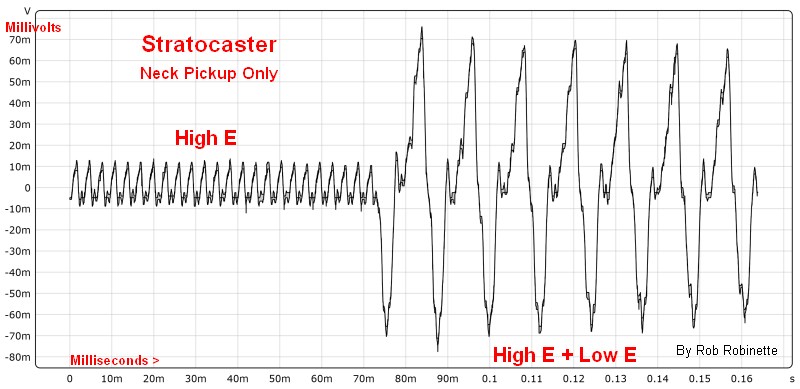
Each test was with an open E1 (low E string - actually E2 on the piano scale, 82.4Hz), open E2 (high E string) and an open E-Major chord, using the neck pickup, middle pickup (Strat copy only) and bridge pickup. The bass only has one pickup, and I used an open E, open G and a two string 'chord'. Each sample started at the 250ms trigger point, and lasted for 3.75 seconds. This proved to be long enough to get a reasonable idea of the overall trend in each case.
The oscilloscope shows the RMS level averaged across the full four second sweep, and while it's not particularly accurate, it is a useful indicator of what you can expect. Note that these were all taken with volume and 'tone' controls set for maximum, and with a 10MΩ load via the scope's ×10 probe. Most pickups will not start to show any significant loss of level until the preamp's input impedance is less than 68k or so, and even then it can be hard to discern.
Tabulated results aren't especially useful, for the simple reason that there will be huge variations due to playing style, and what's being played. However, I did summarise the results. All numbers are millivolts (RMS) taken from the scope captures shown below. I didn't include the bass, only the two guitars. Note that I use light gauge strings, and you will get more level with thicker ones. I don't have a set for comparison, but I'd expect that you could get at least 6dB (×2) more level when played hard. The pickup resistance is also shown in the table, not because it's especially useful on its own, but you can make comparisons. It includes the parallel resistance of the volume control, as I didn't feel like dismantling my guitars for a more accurate measurement.
Spark Amp Headphone Output
I've only included the guitars in the table, and not the two basses I also measured. Feel free to compile your own table from the info in the bass sections.
From the table, it's apparent that the individual voltages can vary widely, but the averages are useful for anyone looking at how much gain a guitar preamp or effects unit will need. With a maximum average output of 128mV RMS (with the peak at just under 1V), a preamp with too much initial gain will distort readily, and it's not affected by the preamp's volume control. On the other hand, an average level of 29mV RMS means that you need more gain than you might have thought. In general, the maximum gain for the first stage should be no more than 20 (26dB) for a 'solid state' preamp, but an overall gain of more than 200 (around 50dB is 'typical') is needed to drive a power amplifier to full power (assuming 2V input sensitivity). Of course, this varies with frequency and tone control settings.

Valve preamps can usually handle more gain without clipping, but that's far from guaranteed. It depends on the way the input valve is biased, and high-level transients can push the input valve into grid current well before the maximum output level is achieved. The cathode voltage needs to be greater than the highest likely transient to prevent grid current. If the input valve has a cathode voltage of 800mV, the maximum level before grid current is also (about) 800mV, which may not be enough if the guitar has 'hot' pickups or is played hard.
Watt Guitar Amplifier
Of course, if a guitar pickup is 'hot', you can always use the volume control on the guitar to keep preamp distortion at bay, and get some 'bite' if the volume is turned up to eleven (or even just ten
). It's also easy to see why most guitar amps have a significant amount of treble boost - it's necessary because the output of the higher strings is almost always lower than expected. As the strings get thinner they have less interaction with the pickup's magnetic field, producing less output (and usually far less sustain as shown in the scope captures).

The bridge pickup is a humbucker, and the scale has been increased from 100mV/ division to 200mV/ division. This was needed so the waveform wasn't clipped by the scope. The peak output level is up to 800mV, a significant increase in terms of the scope, but it's only 3dB more than the highest level recorded from the neck pickup.
You Can Diy!: Build A Single Ended Guitar Tube Amplifier
This was done the same way as was the table for the guitars. The data are simply tabulated from the individual scope trace images, and averages for both peak and RMS were determined. The levels overall are much lower than from either guitar. I played an open E, open G and a two string 'chord' for each measurement.
The two basses may not be fully representative of original commercial offerings, but then again they might be. The 'home made' bass has always had an issue with open-E being somewhat 'subdued' compared to other notes - it may be the pickup position, but unfortunately that's not easily changed. I would expect the output to be lower in general, because the velocity of the strings is less than a 'normal' guitar. The distance between the strings and pickup is also greater, due to the heavy strings and relatively large amplitude. If the pickup is too close, the strings can easily rattle on the pickup. I also used a pick to get a (hopefully) more consistent level. I tested (but didn't capture) a 'slap' style on several strings, and the output was a great deal higher.

The neck, fretboard and tuning heads are commercial, but the original body was replaced with a piece of solid timber (suitably shaped of course) many years ago. This was a (futile) attempt to improve the E-string performance, which was always a bit 'meh'. Obviously, it can be used with appropriate EQ to restore the missing 42Hz. The pickup is a 'Fender Lace Sensor', and it's equipped with a 'Badass' bridge.
All About Direct Boxes
The provenance on this bass is unknown, but I think it's a Chinese 'semi-copy' of a Fender Precision bass. It has no neck pickup, but has one 'middle' and one bridge pickup. The levels seem fairly consistent with the other bass, with the exception of the levels obtained by finger 'picking' rather than a pick. The pickups both measure 7.9kΩ (including parallel volume control resistance).
I didn't include the bridge pickup for this last test, as it's fairly anemic compared to the 'middle' pickup. The ratios will be more-or-less the same though, so expect to get roughly double the output shown if using finger-picking. 'Slap' (or 'popping') will naturally be higher again, but this wasn't tested (the output can be a lot higher, and most bass amps will be pushed into distortion if you use this style of playing. This usually doesn't matter, as slap bass tends to be distorted anyway as the strings vibrate on the fretboard.

The information here has been compiled with care, but your guitar or bass will be different. It's obviously impossible to provide data on every possibility, but the figures I obtained are likely to be representative of many standard commercial products. If you have active pickups (needing a battery to operate), then the levels will generally be higher, and you will have to take your own measurements
0 Response to "Guitar Amp Output Voltage"
Posting Komentar