We’ve now learned how the musical alphabet maps out on the fretboard. There is a whole step between the notes except between B to C and E to F which is a half step.
But how do you name the frets that fall between the musical alphabet? What is the note a half step above C or a half step below E?

C sharp is written with the sharp symbol after the alphabet letter (C♯). However, when written as a note on the musical staff, the sharp is always written before the note.
How To Learn All Notes On Guitar
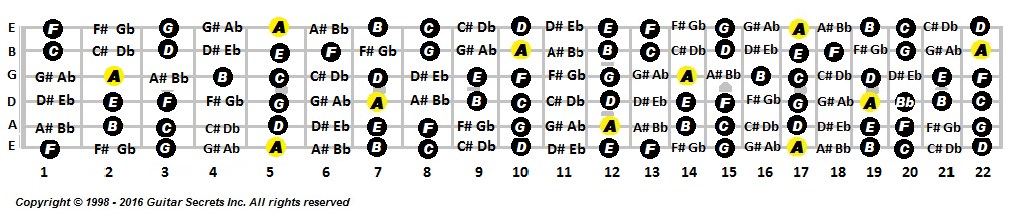
Applying that to the guitar fretboard, you can now fill in the blanks and name every fret inside one octave. I’ve matched the coloring of the piano keyboard.
For example, there is a C note at the 3rd fret on string 5(A). The note C♯ (“C sharp”) will therefore one fret higher in the 4th fret (refer to the TAB above).
The term ‘sharp’ can also be applied when tuning an instrument. Any note that is a little higher than it should be can be described as sharp (“that note sounds sharp”) and should be lowered to bring it to the correct pitch.
Sharps And Flats
The potentially confusing thing is that there is another way that the black keys can be named, lowering down from a white key.
D flat is written with the flat symbol (a wonky-looking lower-case b) after the alphabet letter (D♭). However, as with the sharp note, the flat symbol will be written before the note head on the musical staff:
Applying that to the guitar fretboard once again, you can now fill in the blanks and name every fret inside one octave using flat notes:
Theory Of The Major Scale — Music Is Win
To make any note flat you lower it in pitch by one fret (a half step). For example, we have a D at the 5th fret on string 5(A). The note D♭ (“D flat”) will therefore one fret lower in the 4th fret.

Again, the term ‘flat’ can also apply when tuning an instrument. Any note that is a little lower than it should be can be described as flat (“that note sounds flat”) and should be raised to bring it to the correct pitch.
For now, though (especially as you’re learning the fretboard) it’s best to remember that a half step above E is F and a half step below C is B.
Ultimate Eb Tuning (e Flat) Resource: Chords, Songs, Diagrams
Two notes which have the same pitch (for example C♯ and D♭) are called enharmonic. Exactly how they are named depends on the key and scale you are using.
You will find that you see one name for a note more often than the other (for example we see B♭ more often than A♯, or F♯ is seen more often than G♭).
As a useful visual aid to see how all the notes relate to one another you can think of the 12 notes in an octave as being like the 12 numbers on a clock face.
Why Are Some Of The Notes Flat, While Others Are Sharp?
The note clock shows all the 12 notes that exist in music. Moving clockwise makes the notes higher in pitch. Conversely, moving counterclockwise makes the notes lower in pitch.
Each step around the clock is a movement up or down a half step (a movement from one fret to the next horizontally).
You can use the note clock to identify any note on any string. Pinpoint the fret number and identify the note name of the string being played. Then, from the open string note on the clock face, move clockwise a number of steps equal to the fret number and you will know the note being played.

What Two Notes Have No Sharps?
For example, if I wanted to identify the note at the 5th fret of string 1(E) I would find the E note (at the 7 o’clock position) and count clockwise 5 steps. The note at the 5th fret of string 1(E) will therefore be an A (seen at the 10 o’clock position).
The symbol for a sharp note is the hashtag (#) symbol, which is said and written after the letter (but appears before the note head in music notation).
The symbol for a flat note is the b (♭) symbol, which is said and written after the letter (but appears before the note head in music notation).
Mastering The 15 Most Important Guitar Chords For Beginners
The notes that fall in between the musical alphabet can therefore have two names. Which names is used will depend on the scale used and the key of the music (we’ll be looking into this soon!)

0 Response to "Flats And Sharps On Guitar"
Posting Komentar