Recently I wanted to use two different effect pedals in parallel, but didn’t have anything handy that would easily allow me to split and then re-combine the signals. So I designed and built one! It’s a very simple device consisting of a passive multiple and a 3-into-1 audio mixer with input level pots and a single output.
The mixer circuit uses a single transistor and runs from 9V DC, so you can power it from the same supply you use for your pedals. It draws only a few milliamps. The multiple is entirely optional – it’s purely passive and is just 4 jacks tied together, but it’s a useful addition and you could fit both this and the mixer into the same enclosure.
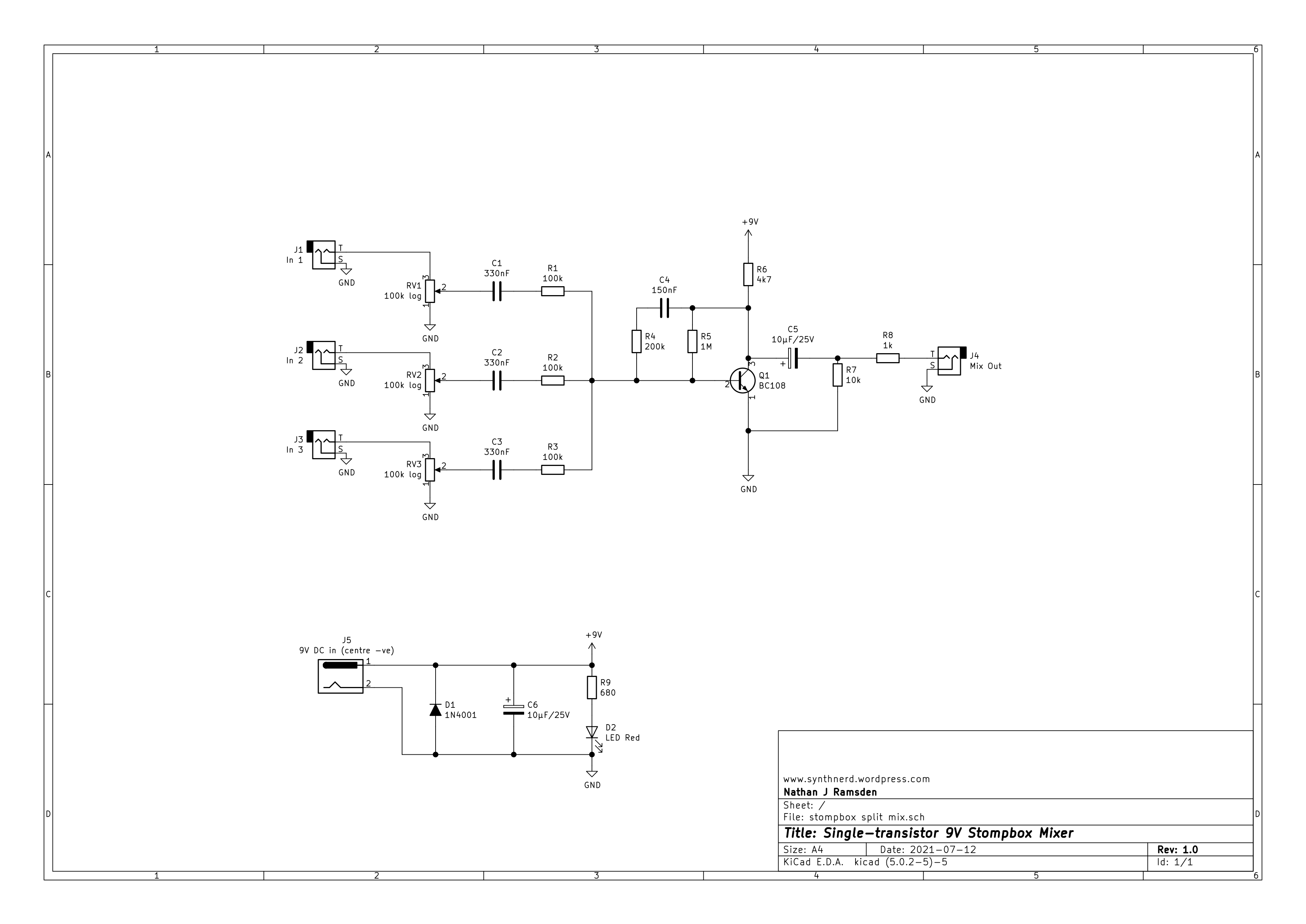
This is a very simple single-transistor design that uses a generic NPN device. The circuit is a ‘common emitter’ type (a basic description can be found here). Signals are presented to the base, and the output is taken from the collector. In order for the output to be able to swing up and down (audio signals are AC, don’t forget), the collector needs to sit somewhere a little above half way up the supply when nothing is happening. Given that we’re running this from 9V, it’s only really suited to relatively low audio signals, but we still have enough headroom for a small number of mixed inputs. I had no trouble mixing three audio test signals.
How To Record & Mix Acoustic Guitars
I won’t go into much detail about all aspects of the design process here, but the core is the transistor Q1, the resistor R6 from collector to 9V, and the resistor R5 from base to collector. The gain (Hfe) of Q1 together with these other values sets the collector voltage around which point the signals are mixed. The first job is to pick a transistor.
A simple way to choose a transistor is to build the test circuit shown here, using just Q1, R5, and R6. Connect power and measure the voltage at the collector. The aim is to get a voltage here a little over half supply, but not too much higher. Something in the region of 5V is fine. I picked a BC108 with Hfe of around 220, which was my starting point for the other component values in the circuit. The 2N3904 is also a good choice, and easy to find. Hfe is not a precise value for any device but a ballpark of 200 will suit nicely.
If you find your transistors all giving collector voltages nearer to 4.5V or even lower, and sourcing alternative devices is not an option, try decreasing the 4k7 resistor value – for example, if your Q1 Hfe is nearer 300, a 3k3 resistor will suit better.
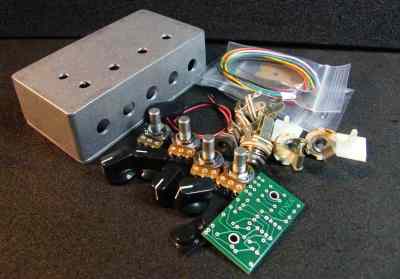
Madbox Splitter/mixer Kit, 18,00 €
I should stress here that this design is absolutely a compromise for the sake of simplicity. ‘Close enough’ is fine. The risks are lower headroom and some distortion.
The inputs are brought in via potentiometers and decoupled using small capacitors. Three input resistors mix the signals into the transistor base. Note that the capacitor and resistor in series on each input acts as a low-cut filter to reduce sub-audio content.
In parallel with the 1M resistor discussed before, we add another resistor and capacitor across the NPN’s base/collector (R4 & C4). This does several things, not the least of which is to set the gain of the inputs. The 200k resistor, in tandem with the 100k values at the input, would suggest a gain of 2 (200k/100k = 2) but the real value is somewhat lower. In practice, with these values I found unity gain around 80% of the way around the input level pots, so there’s a little bit of boost available to help balance levels if you need it. The pots, by the way, should be log (or audio) taper.
Diy Mixer Pedal?
I used a standard 9V DC barrel jack of the kind seen on many effect pedals – in this case the positive tends to be on the outer sleeve, and ground on the centre pin, Boss-style. A diode across the input protects against reverse connection, the capacitor helps smooth the incoming supply, and a resistor/LED draws a few milliamps to indicate ‘power on’.
This is simply four jack sockets with their ground/sleeve connectors tied together and their tip connectors tied together. Please note, they are intended to split one signal several ways, not to combine signals.
Here are some photos of the build. You can see there’s lots of room in that enclosure, but I wanted something that was stable on the desk with a few cables hooked in. It’s possible to make the final unit quite small as the circuit itself takes up very little room. Designing a layout is your only challenge. Of course you can use any kind of box, sockets, and knobs that you like. I hope you find this useful!
How To Build A Diy Passive Summing Box
Tags: 9 volt, 9v synth circuit, analog, analogue, BJT, circuit bending, compact mixer, desktop mixer, discrete audio circuit, diy audio mixer, DIY electronics, diy mixer, effect pedal mixer, fx pedal, mixer circuit, mixer schematic, NPN, parallel effects, synth diy, synth mixer, synth mods, Synthesizer, transistor circuit, transistor mixeWell, I didn't want to just stop after posting about the guitar. I have been known to dabble in other little projects after all. So don't be surprised if those other projects make it on here for time to time.
Today I'd like to show you the little two-channel passive mixer I made. I needed something that would let me plug two guitars into the same amplifier (and both be used at the same time). So, if someone were to come round to my house, we could both plug a guitar into the same amp. You can't just use a y-connector, since that's just amateur, and changing the volume on one guitar would affect the other. I'm pretty sure it could be unhealthy for certain amps too. Also, I wanted to be able to adjust the level of each guitar so that if one were more powerful than the other, this could be balanced out. Lastly, I wanted to make it as portable as possible, so that I could even stick it in my guitar case.

Note that I don't claim to be the inventor of that circuit. Five minutes on Google and I'm sure you'll find a similar circuit posted on other sites. I have, however, drawn a nice clear circuit diagram for your convenience.
Peavey Xr600c Mixer Amp 6 Channel Powered Pa Head
As you can see, the circuit is incredibly simple. Just three quarter-inch jack sockets, two 10k logarithmic pots, two 10k resistors and a box to stick them in (see notes just below).
NOTE: I've noticed several forums pointing to this post, and a lot of debate about the 10k values of both the pots and resistors as being too low (it has been suggested that 500k or even 1M pots would be better, for example). I've used this mixer a lot, as has a friend of mine who I made one for, and both of us have found that it does a perfectly good job, especially at home. My advice is to just give it a go and see how it works for you, rather that wasting too much time in advance theorising about how it might sound. If you find that it doesn't sound good to you, then by all means try different pot/resistor values, and report back in the comments below.
NOTE 2: See the comments at the bottom of this post for more discussion about this. 250Kohm pots and resistors seems to be a good choice by the looks of it.

Channel In, 1 Mono Out. Mixer Pedal?
I couldn't find a suitably-sized metal enclosure at the time of making this, so I settled on a plastic box with a metal bottom. My thinking was that I could always line it with tin foil (aluminum foil) if it picked up interference, but to be honest, it has never been an issue.
As you can see, it only just fitted in there. It may have been a better idea to put the two input jacks to the outside of the pots, but to be honest, I don't think it matters either way.
I've been able to use this little device on a few occasions, and it's been fantastic. The fact that it can fit into your pocket makes it incredibly handy too.
Swamp Diy Build Your Own Electric Guitar Kit
I haven't been in this position yet, but it could even save your ass if you were at a small venue with another guitarist and one of the amps stopped working.

Also, just one more comment from me - I ended up re-boxing this mixer. I never had any problem with interference, but I decided to re-box it in an aluminium enclosure anyway, since I found a size that was just perfect, and I liked the idea of it being more robust. Here's the re-boxed mixer:
0 Response to "Diy Guitar Mixer"
Posting Komentar