Don't worry, it's part of the learning process. Be comforted by the fact that all beginners go through this, and the pain will go away with time once your calluses develop.
Actually, after a while, you'll get to like the feeling of soreness in your fingertip, since it'll mean you had a good practice session.

Keep on reading, I'll show you what they will eventually look like and how to get them to form quickly, so you can play guitar 24 hours a day 🙂
Guitarist Calluses: Resilience In The Hands
They are areas of hardened skin on your fingertips that develop as a result of skin irritation, ie. your skin being put out to constant friction and pressure due to contact with guitar strings.
Before you form calluses as a newbie guitar player, your practice time will be very limited because of the pain in your fingertips. With time, practice, and callus care, your calluses will act as shields protecting you from the pain of fretting strings.
We, as guitarists, develop calluses on our fingertips, from fretting the strings on the guitar. Here are a few tips on how to develop finger calluses faster:
We Talk A Lot About Calluses On The Fingertips, Any Experienced Guitarists Have Calluses On The Pad On Their Pointer Finger? I've Been Learning A Lot Of Nirvana Lately (lots Of Barre
Almost as important as the above, there are also a few things you should stay clear of if you want to develop calluses quickly:
Stick to the above recommendations, and you'll be on your way to hardening your fingertips and building those guitar calluses as quickly as possible.
The amount of time it takes to develop calluses on your fingers, and in turn, not have sore fingertips anymore, depends a lot on whether you do things right.
Simple Tips On How To Build Guitar Calluses
If you stick with my recommendations above, and practice at least 30 minutes per day, lengthening that as you can, you should see results pretty quickly:
Everyone who learns to play the guitar has to deal with sore fingers at the beginning. There are things you can do to reduce the pain, but in turn, your calluses will form slower, so you're basically extending the period of lessened pain.
This article is around 1, 000 words long, so if you started reading this article with sore fingers, the pain should have eased by now. It's time to practice for a few minutes again 🙂
Is There A Way To Avoid Guitar Calluses? Yes! Here's What I Did Unintentionally ⋆ Chromatic Dreamers
One of the most common questions I get from my students (both online and offline) is: Tom, what’s theeasiest way to learn guitar? If I had a dollar for every time I heard that 🙂 So, myyoung Padawans, let’s have a look at this question in detail. Can learning guitar be easy? If you are…
If you’ve ever contacted me on any guitar-related question, you’ll know that I answer all of my students’ questions personally. I love doing so for people learning from our beginner guitar lessons. There are a lot of typical questions and problems that my online students encounter, so I thought a post on these would be…
All beginner guitarists struggle with switching between chords at first, thats part of the learning curve. Here are some tips on the subject, but make sure you watch our video lesson on how to change between guitar chords, where I will show you the correct technique of learning chord changes. Watch my hands closely to…
Guitar Calluses: Development, Maintaining, And Helpful Tips
The guitar is the single most popular instrument in the world. It is played by millions of people in all countries, by all races, of all religions. On top of the millions who play it already, there are probably 10x more who want to learn the guitar, and are seeking the best beginner guitar lessons….

Learning the names of the guitar strings in standard tuning is easy when you have something to tie the letters to. This is exactly why people started making up memory aids: to remember the string names (EADGBE). If you’re looking for how to remember the strings on a guitar, here are a couple of mnemonic…
It’s inevitable that when you set out on learning something new, you will make mistakes. This is true for learning guitar as well. Being a private and online guitar teacher, I’ve helped a lot of beginner guitar students get through the initial hardships, and have observed several very common beginner mistakes newbies tend to make….Forget about the tall tales, the marketing schemes, and the urban legends. Nobody wants their fingertips raw and wounded from playing guitar.
Ways To Minimize Finger Pain From Playing Guitar
As a beginner, it’s bad enough to need to restrict your practice time because your fingertips are tender and squishy. You might only play for 30 minutes but the next day your fingers are bruised and possibly have been cut shallowly.
And god forbid you don’t practice for a few days and end up starting the process over again. The solution to all of these woes is to build guitar calluses and to then care for them.
But there are also tips and tricks to help you out before you get to that point too. We’re going to cover the three stages of developing calluses, caring for your fingertips, and then how to deal with calluses peeling off.
How Long Does It Take To Get Proper Calluses? Been Playing ~6 Weeks. Despite Having Calluses The Strings Still Hurt Sometimes, Esp. If I Was Playing Earlier That Day. They Also Leave
Let’s start with the obvious and define exactly what a callus is for the newcomers and then we’ll jump into the meat of the discussion.
A guitar callus is a thick pad of skin that develops on the fingertips of a guitarist’s non-strumming hand from their constant manipulation of the fretboard and strings.

This toughened area of skin develops over time as the body’s protective measures kick in in response to repeated and consistent friction and pressure to a portion of skin. Calluses serve to desensitize your fingers from pain.
My Fingers After Playing Guitar For 4 Hours Straight.
So basically your neck hand’s fingers realize you’re not going to stop making them suffer against these guitar strings, so they start growing armor to defend themselves. Unfortunately this takes a bit of time and persistence.
You have to push through the period of pain to earn these little badges of honor. It’s totally worth it and something guitarists have dealt with since the beginning, but we’ve also developed quite a few tricks to help get past this initial hurdle too. Let’s discuss this time period first.
Let’s preface this by saying that yes, there are ways to hasten growing calluses but it will always take commitment to the process. There’s no shortcut around that, and nothing can replace having to do the actual work. Here are the methods to toughening up your fingertips fast:
How To Deal With Guitar Finger Pain And Calluses
Shorter, Frequent Practice Sessions – Of course, the tried and true method of developing calluses is to continue practicing the guitar or bass regularly. You’re far better off playing for 10 minutes at a time several times a day than going for a long 2 hour burst and then not playing again for days.
More frequent sessions of less duration are not only better for learning but will accelerate the rate at which you grow calluses. Long sessions before you have solid calluses are how you end up with blisters instead.
Spend Time With an Acoustic Guitar – This may be your goal already, but many strictly play electric guitar. Most people will have the action of their electric guitar adjusted and use light strings and be all dainty about it because it makes it easier to play.
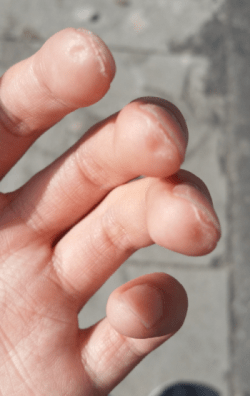
Eventually With Practice You Will Build Calluses On Your Finger Tips
But an acoustic with steel strings requires more force and usually have higher action too. If you tolerate this long enough while avoiding the smooth nylon strings of a classical guitar, you’ll grow your thick skin pads faster.
Start With Medium or Heavy Strings – When you’re absolutely new, you have two choices. You can try to avoid the soreness of pressing down a heavier string by using light gauge strings, but then you risk cutting your fingers since you don’t have the protective skin layer built up yet.
You’re better off pressing and rubbing against thicker gauge strings with their ridges and bumps, which will quicken the rate of growing calluses. We give our suggestions on string gauges and brands in our Guitar Strings Guide.
How To Build Calluses For Guitar And Toughen Up Your Fingers
Keep Your Fingernails Trimmed – You’ll often see guitarists chewing their fingernails on their left hands to a visually uncomfortable level of shortness. The reason they’ll tell you is so their fingernails don’t scratch their fretboard, but the main reason is that it stops you from playing as well.
If your fingernails are hitting the strings on the neck, then they’re relieving pressure and friction from your fingertips. This will slow down the process of growing good calluses and can lead to ugly situations when you try to slide and end up tearing off a piece of a nail.
Use nail trimmers though, don’t chew your fingernails. It’s easy to overdo it and be left with a different kind of finger pain, like ingrown nails, infections, or exposing the sensitive nail bed.
Why Do You Need Guitar Calluses And How To Build Them
Reduce the Pain – If you do this, you need to make sure you’re still paying attention to your fingertips in case you’re doing some real damage and don’t realize it. But the idea is that through some home remedies like witch hazel and medicine you can block out some of the pain.

I don’t think this is the greatest idea, but your mileage may vary. Some suggest that a 30 second apple cider vinegar soak can help
0 Response to "Calluses Due To Guitar"
Posting Komentar