Wondering how to play bass guitar? This beginner guide will teach you the fundamentals quickly. We’ll cover bass string notes, bass guitar scales, the vital importance of root notes & the only 2 arpeggio patterns you need. Let’s do it!
If you wanted to be the bass player in a band, it meant lugging one of those huge upright double-basses you see in orchestras and jazz bands to and from band practice.

To learn how to play bass guitar you’ll need to know the notes of the strings. The four strings of a bass guitar are tuned the same as the lower four strings of an ordinary guitar.
Bass Guitar Chord Notes Mini Chart
These notes are the same as a standard guitar but they’re an octave lower. In layman’s terms, this means they sound deeper and lower and…. Well, bassier!
As you begin learning how to play bass guitar, just play the 4th string (the E string). As you progress you can start playing on the 3rd string and eventually the 2nd and 1st. But to begin with, stay on the 4th and make things easy! 🙂
Your job is to provide a regular and rock solid beat (along with the drummer) that provides the rhythmic foundation of a piece of music.
Bass Note Strumming Pattern
Some famous/notable bass guitarists are: Suzie Quatro, Kim Deal from The Pixies, Bruce Foxton from The Jam and Flea from the Red Hot Chili Peppers.
What’s a root note? Well if the rhythm guitarist in our band tells us they’re playing a G chord, we need to match that with a G note. That’s basically what a root note is.
There’s two ways we can pluck a bass string. Either using a guitar pick or using the first two fingers of the picking hand.
Blog: Bass Guitar Fretboard Charts: Understanding Your Bass At A Glance
If we’re using a pick, we want to use down and upstrokes to keep a nice, steady groove going on our G note. If we’re using the two fingers, we want to alternate between the two in a sort of ‘walking’ motion on the string.
The two main things to make sure of are that we’re playing the right root note for the right chord and that we’re playing it in time.
There’s lots of different rhythms we might find ourselves needing to play, but for the moment, try counting, “1 and 2 and 3 and 4 and 1 and 2 and 3 and 4 and…” and play the G note at that pace.
An Introduction To Reading Music
Be sure to keep your counting even; don’t speed up or slow down mid-count. If you want to learn how to play bass guitar, your timing has got to be impeccable.
Even if your dream is to play like Flea from the Red Hot Chili Peppers or Bootsy Collins from James Brown’s band, it’s best to keep things simple to start with.
Let’s say our chord sequence is two bars of G, followed by one bar of D and one bar of A minor, playing in a continuous loop.
The Notes On The 6 String Bass Guitar!
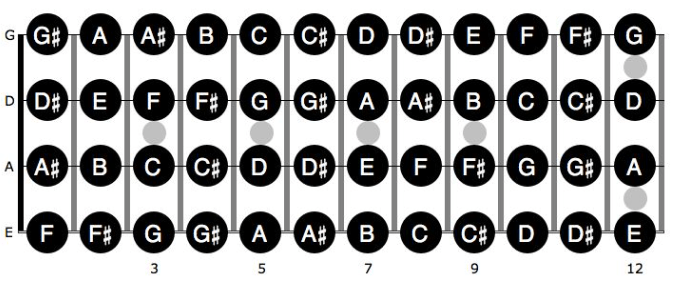
The roots we need are G (3rd fret on the E string), D (5th fret on the A string) and A (5th fret on the E string). See below.
Remember, as a bass guitarist, you and the drummer form the core of the rhythm section of a band. With that in mind, it’s important to keep things rhythmic.
Root’s can get a bit boring after a while, especially if there’s a lot of bars of the same chord, so there are some things we can add to our bass lines to give them a bit more flavour.
How To Read Bass Tab
A bassist who plays nothing but roots, but makes sure they are the correct roots played at the correct rhythm and tempo will always beat a bassist who plays all over the fretboard with no regard for the chord sequence or song structure. How To Play Bass Guitar: Arpeggios
If you want to learn how to play bass guitar, you must master the major and minor arpeggios. Don’t worry, they are both very simple patterns.
Take your time and have a few goes at this. This is a crucial pattern for a bass player to know. (You will use this again and again.)
Bass Guitar Major Scales Notes
If you want to learn how to play bass guitar you have to learn to use all of those digits. Don’t just hop around using the fingers that are already strong, we need to get comfortable using all our fingers!
My advice would be to start with the middle finger on the 3rd fret note, then use the index finger for the 2nd fret and the pinky finger for the 5th fret.

Your little finger may not feel particularly strong right now, but that’s all the more reason to get using it. Build it up! 🙂Whether you are a complete beginner or have been playing for a while but don't quite know all of the fretboard; this lesson is for you!
Amazon.com: 5 String Bass Guitar Fretboard Note Map Decals/stickers
The bass guitar is an instrument of shapes and patterns. We can use these to help us learn the entire fretboard with ease. Watch this 60-second video to see 5 cool things you can do when you know the bass guitar fretboard well.
View this post on Instagram Make learning the entire fretboard a priority. It’s so useful! Here are just 5 things you can do more easily if you know your fretboard. #learnbass #bassguitar #fretboard #music #musictips #fenderprecision #doublestops #transposition #solos #reading #fills A post shared by Bass Guitar Tips & Lessons (@) on Feb 21, 2018 at 7:27am PST
The fretboard may look confusing at first but it's actually really easy to learn once you know a few key points. Let's get right to it.
Learning The Basics Of Bass Tabs
The piano was invented way before the bass and the seemingly random order of notes on a bass is best explained by looking at the piano. The musical alphabet goes A B C D E F G. No H or above. So the notes repeat themselves when you get to G.
A sharp (#) is when you go to the next highest (right on the piano) black note from a white note. A flat is when you go the next.
- Every other note has a gap of a fret. Look at the piano picture again. These ‘gaps’ are the sharps (#) and flats (b.

How To Learn Notes On The Bass Fingerboard (3 Parts)
- Notes get higher when you go this way on a bass ———-> and a sharp is added when you go to the next highest fret.
- It REALLY helps to learn the piano keyboard as it explains why B and E don’t have a sharp (B and C, and E and F have no black note between them.
Notes get lower in pitch when you go this way on a bass <———- and a flat is added when you go to the next lowest fret.
Bass Scales Reference: All Bass Guitar Scales Tab, Notation & Patterns
- Same as before, when you go one note to the left you ‘flatten’ the note. C and F don’t have a black note left of it on a piano (check the diagram again) so that’s why you don’t see a flat there on the fretboard diagram.
Spend as much time as you need getting your head around all this and then use the exercises and patterns from the other lessons on this blog to memorise the notes. It really doesn’t take long at all to learn EVERY note on the fretboard.
I send 1 email every Sunday with free lessons, pro tips, gear, gig advice and more. Your details will not be passed on or shared with any other party. Privacy policy.
How To Find Any Note On The Bass Guitar
If you get any value from my lessons and would like to help keep this site running and the weekly lessons flowing, click the button below for a small donation. Even something small really helps me cover running costs!

My weekly Bass Bites newsletter is packed full of bass tips, news, and lessons, plus you'll get an exclusive free copy of The Bass Guitar Resource Book!
Please log in again. The login page will open in a new tab. After logging in you can close it and return to this page.
0 Response to "Bass Notes Bass Guitar"
Posting Komentar