This post contains affiliate links, meaning, if you click through and make a purchase, I may earn a commission. This is at no additional cost to you. Learn more.
In one of my previous articles, “Action! A Beginners Guide to Understanding String Height, ” I introduced you to the concept of string height, or “action” (the two terms are used interchangeably throughout this article). However, in that article I didn’t say exactly

It’s a great question, because when you’re new to guitar you really have no frame-of-reference for what a “good action” is or what it feels like.
The Correct String Action
As you spend more and more time with the guitar, you’ll eventually develop a personal preference for what action feels right for you. In the meantime, I’ll give you some specific measurements here that you can use to judge whether your guitar is currently set up with low, medium, or high action.
When it comes to measurements, the guitar world seems evenly split right now between imperial (inches) and metric (millimeters). Still others like to use fractions.
Here, I’ll be giving all measurements in millimeters and decimal-inches, because that’s what I’m most familiar with. Also, that’ll allow you to use the String Action Gauge that I recommend in this article, regardless of whether you choose the version that’s in millimeters or inches. If you’d like to use fractions, you’ll need to do the conversion to find your values.
Easy Ways To Adjust The Action On A Guitar (with Pictures)
Measuring and setting guitar string height involves dealing with very small measurements. You can’t use those cheap plastic rulers you used as a kid, nor a tape measure. Here are the things I use to measure string height (useful for other guitar measurements too):
To be honest, this is the only measurement you need when talking about action, but later in this article I’ll discuss the
Of measuring at the 1st fret too. You’ll take this measurement at the 12th fret with the strings open (unfretted). We only measure string height under the two outer E strings (thickest and thinnest strings). There’s no need to measure the middle 4 strings. Here’s what you do:
Ask The Luthier
This is important. Do not measure string height with the guitar on its back, because gravity will bend the neck just enough to make your measurement inaccurate:
We’re dealing with very small, very precise measurements here, and that’s why you need an accurate measuring tool like the String Action Gauge I’m using here:
A string action gauge isn’t the only way to measure string height, but it sure makes life a lot easier. I much prefer this over using a ruler.
Guitar Setup: How Do I Measure The Action On My Electric Guitar?
The horizontal black lines on the String Action Gauge are 0.1mm thick. Since my string is slightly above the black line here, I need to add 0.1mm to the measurement shown. So, according to what you see here, the string height of my low E is roughly 2.1mm.
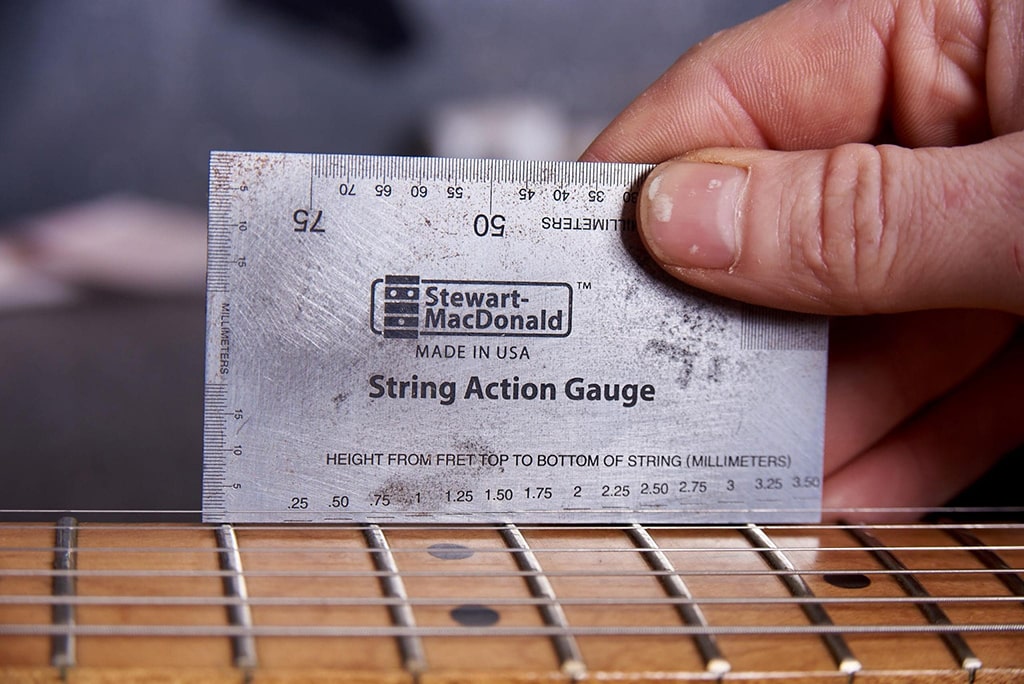
3. Next, measure the height under the highest (thinnest) string in the same manner. It’s normal for the string height to be a bit lower under this string:
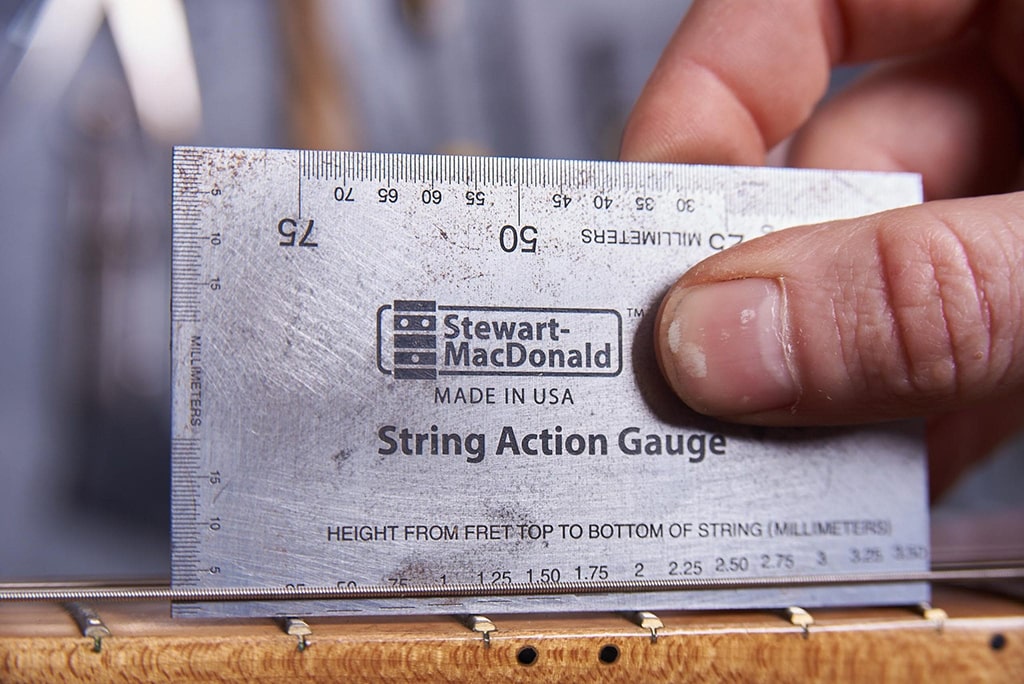
Reading the height on the high E string can be a little tough. It’s hard for you to see here due to the quality of the photo, but my string is sitting right on the 1.5mm line, so my string height on the treble side is exactly 1.5mm.
Michałkaszczyszyn.com » String Action
Note: Some people (and guitar manufacturers) measure string height at some fret other than the 12th… such as the 17th. Some measure action by first placing a capo at the 1st fret before taking their measurement. I don’t do any of that, but it’s important for you to know this so you can ask your guitar tech how THEY measure. That way the two of you are speaking the same language when/if you take your guitar in for a setup.
When you’re just checking your guitar’s action, it’s not really critical to measure at the 1st fret too. Usually, we only measure the 1st fret if there’s a problem we’re trying to diagnose, like bad intonation, open string buzzing, or strings that are too hard to press at the 1st fret. However, in case you’re curious, here’s how it’s done:
2. Using a feeler gauge, measure the distance from the top of the 1st fret to the underside of the lowest (fattest) string.
Action At The 4th Fret Of 6th String
Measuring 1st fret action in this manner is difficult (just try it, and you’ll see what I mean). This is why we usually do the “3rd fret press test” instead… which I’ll tell you about at the end of this section.
In reality, I don’t actually “measure” string height at the 1st fret anymore, nor do many experienced guitar techs or luthiers. Instead, I use the “3rd fret press test” (which is demonstrated by luthier Frank Ford on his website here) to get a general sense of whether the action at the nut is correct.

Generally speaking, while pressing the string at the 3rd fret, you want just the tiniest bit of clearance between the string and the 1st fret, but not too much. You don’t want the string touching the fret either when you press–but if that’s the case you were probably already getting string buzz on the open strings.
Common Setup Problems Affecting Beginners
Though subjective, this is method is usually sufficient to ensure you’ve got the right amount of string height at the nut, though it doesn’t give you an actual measurement.
Now that you know the proper way to measure your guitar’s string height, let’s talk about some actual numbers. When taking your guitar in for a setup, you should always give the repair tech actual measurements when telling them how you want the action set. Vague terms like “low”, “medium”, and “high” are open to interpretation and may not get you what you’re expecting, depending on who works on your guitar that day.
The following measurements are approximate, not “official.” You’ll get slightly different opinions on these measurements depending on who you ask, or where you search on the Web.
Vencetmat Guitar String Action Gauge String Height Ruler Guitar Fret Rocker Fret Levelling Guide Buzzing Fret Catcher 1mm Thickness Laser Etching High Precision Graduation Guitar Building Tools
Now, you not only know how to measure your guitar’s string height or “action, ” you finally have some idea of where your guitar falls on the spectrum of low, medium, and high action. Of course, you can break this down further and talk about medium-low, medium-high, etc. but don’t worry about all that right now. Obviously, there are spaces in between the measurements I gave above, but those should at least give you an idea of where you stand.
Unfortunately, there is no correct or official answer to this. The fact is, a “good” string height is whatever feels good to you. In other words, the goal isn’t always to have your guitar strings as low as possible. There are drawbacks to really low action, as I point out in my other article. Some players like medium action, and some like it high.
That said, I generally recommend the lowest possible action for beginners just starting out. That way you can focus on learning rather than physically fighting the guitar, at least until you build hand strength and dexterity. As you get better, you can begin raising your action a little (or a lot) if you’d like to.
Guitar Action Adjustment
On my electric guitars, I actually don’t like really low action (not as low as what I list above). I’m somewhere between low and medium, which I find better for bending, and feel I get overall better tone and sustain. Just my personal opinion/preference though. On my acoustic guitar, however, I get those suckers so low that it’s probably illegal in some states.
Do you need to learn how to set up your guitar? If so, there are a few resources I highly recommend for learning this stuff:
What is your guitar’s action? Now that you know how, measure it at the 12th fret and let me know what it is in the comments section down below. Don’t forget to tell me what kind of guitar you have (electric, acoustic, or Classical).I do not have digital measuring clippers to measure my action for my 00-15m. As shown in the picture at the 12th fret, the reading is 2.75mm as measured from the bottom of the string.
How Is Your Action Being Set? (low Vs High Action Discuss)
So the top E needs to be 2.5mm, as measured from the bottom of the string, to be considered average action height?
That's a somewhat high action. I aim for 2.2-2.3 mm for the low E (bass) and 1.6-1.7 mm for the high E (treble).

For a quick check I'll just use my regular 6 ruler -- I've used it enough times over the years that I can get a pretty accurate read with just that. When I'm doing a final setup I'll use my regular calipers (I don't actually have digital calipers!). Using the depth gauge I'll measure from the top of the string to the top of the fret and then subtract the thickness of the string. It takes a little bit of a delicate touch to measure without pressing down on the string. Recently I got the nut depth gauge from StewMac and that also can work quite well for checking action. The gauge does press slightly on the string but the effect seems pretty minimal and can be
0 Response to "Guitar String Height At 12th Fret"
Posting Komentar