: Practice & Theory Stack Exchange is a question and answer site for ians, students, and enthusiasts. It only takes a minute to sign up.
I have composed a modern classical piece of which has sections for violins, cellos, some horns and percussion. The problem is that I did all of that using an electric guitar, so I actually don't know how it really sounds played by instruments I wrote it for. So I would like to know how I can get my guitar to sound like a violin and cello? I think there should be an effect to achieve that sound, but I've been unable to find it.

You can do the standard 'never-ending note' by simply holding it over a string & sliding/hammering up & down the fretboard, but with a little practise you can make it sound like violin/cello spiccato by banging the string with the e-bow to give the note attack - something that cannot be done with volume knob/swell pedal technique alone.
Hofner Ignition Violin Bass, Sunburst At Gear4music
OK, I got the thumbs-up, I'll share my embarrassment... 15second example from a 30-year-old track trying to use an E-Bow as a 'cello'. I sincerely apologise for the drums, & for my stunning lack of technique ;-)
The important part of a violin sound is a gentle attack at the start of each note. Some players use a volume or swell pedal to achieve this: the note is played just as the pedal swells the volume in. Others use the volume pot on the guitar. Strats and Teles are quite easy to do this on, as the knob is close to where the string is picked. Again, the string is played just as the little finger rotates the volume knob from 0 to 10. A bit of distortion can make it sound more like a violin, but that needs to be applied carefully.
If you can play the parts on the unwound high E string, you can use a fiddle bow, as Jimmy Page did. Just remember to rosin the bow and use a cheap one as the guitar strings are hard on the horsehair.
Electric Violin Pedalboard
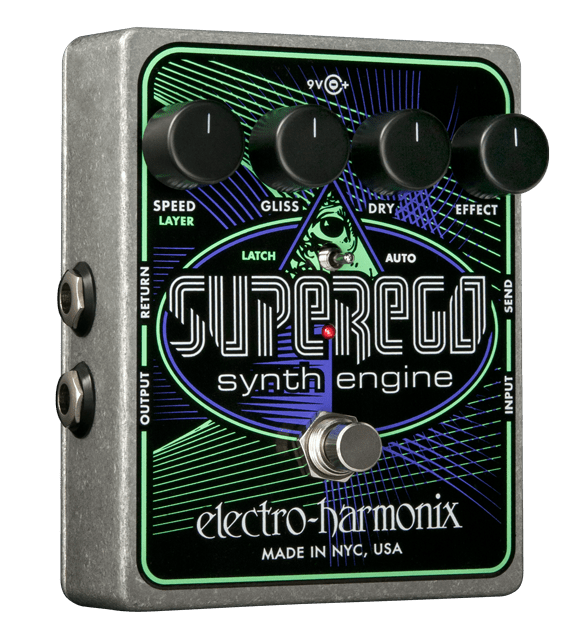
Another alternative is the Electro Harmonix SuperEgo which will allow you to adjust the attack (Gliss) as well as the sustain (Speed);
Yet another alternative is the Electro Harmonix POG2 which allows you to control the attack, adjust the octaves and the low pass filter. I use this one to get a nice arco cello and arco bass sound. The POG2 is one of the cleanest octave pedals I've ever worked with. Very few glitches.
With e.g. a Roland GR-55 guitar synth and special pickup GK-3 you can get semi-convincing violin and cello sounds. Using midi you can connect to a e.g. a DAW and likely get vastly superior results through sound libraries. Not the cheapest solution, but probably closest to the real thing. Could be considered cheating though...
Here's A Weird One For You; I Play More Electric Violin Than Guitar Or Bass, But I Love To Have The Board Work For All Of Them. Suggestions Welcome! I Use The
I'd not bother. Bowing creates a special waveform that is quite different from that of a guitar, being more like a sawtooth (because it basically results from a stick and slide pattern on the bow hair: the violin is built to suck off and transmit much more sound energy than a guitar, so plucked notes don't have significant sustain). That's actually not easy to create from the input of a guitar without tracking the actual pitch because it amounts to something like using overdrive and suppressing the even-numbered harmonics afterwards. If you have something reliably tracking pitch, you are likely better off just feeding a violin synth via Midi.
However, what makes a violin sound actually live is expressiveness particularly in long notes. That means that you should find some pedals that give you subtle ways to make long notes live. Also you should play with a guitar type giving you long-sustained notes by default. So solid-body, light gauge, soft play.
Play, however, is hard to do because of the expressiveness angle. It might be worth working with a reedless accordion as input device since the bellows pressure gives you the kind of intuitive continuous expression input that bowing has.

What's The Difference Between A Silent Violin And An Electric Violin?
Want to give that combination a try, I recommend going for a chromatic button accordion keyboard (regarding the choice of button system: reedless accordions usually allow you to switch. All systems, C/B/G-Griff are pretty much equivalent but the used acoustic instrument markets in various countries tend to heavily favor one kind, so it makes sense to pick a system that will make it easier for you to get the kind of acoustic instrument you prefer).
You'll get quite more range into your right hand and a nicer size factor. Also the controls are naturally spaced. Basically, you are playing a 20-string tap guitar with 4 frets and tuned in minor thirds. No C major scale standing out.
If you are not going to use that kind of setup often enough to learn a different instrument type, you might get along with some kind of Midi guitar (never tried one of those myself). I don't think that you'll arrive at concert-level quality with that, but if your main focus is composer, others are going to play the instruments anyway in concert.
Yamaha 5 String Electric Violin
However, I think that for composing you'll be better off with a proper keyboard instrument in the long run. For example, the chord voicing of various chords on a guitar is untypical for most other instrument types. Keyboard chords are more standard.
I used a pen to imitate the sound of a violin and cello playing famous guitar riffs. No midi, synth or other effects has been used. Can you guess all these songs? Don’t forget to let me know what you think :)
Highly active question. Earn 10 reputation (not counting the association bonus) in order to answer this question. The reputation requirement helps protect this question from spam and non-answer activity.
Guitarists Shouldn't Have All The Fun: The Best Effects For Violin
By clicking “Accept all cookies”, you agree Stack Exchange can store cookies on your device and disclose information in accordance with our Cookie Policy.We have partnered with Klarna & Affirm to offer flexible financing options that allow you to order something today, and pay for it later.
How Can A Piece of Wood Cost $45 Million Dollars? Behind The Price of A New Violin Reading Guitarists Shouldn’t Have All The Fun: The Best Effects For Violin 3 minutes Next Behind The Craft: Fiddlerman 10-Point Adjustment
There is a plethora of accessories guitarists have to choose from. The most iconic of them being stop boxes. Little boxes of circuits and electricity that give depth, texture or transform the instrument sound to something else entirely. The effects come in a myriad of different flavors.
New Pedals, New Board, New Amp For My Violin. Got Tired Of Being Unable To Bring My Pedals With Me So I Swiss Cheesed A Piece Of Plywood
Delay and reverb simulate the audio reflection of a music studio room, concert hall or pushing the effects to uplift the sound as if you are playing in a mountain valley. There are octave pedals that filter and add frequencies to simulate a lower pitch like that of a bass guitar or in a violinist's application, a double bass or cello.
![NPD]](https://i3.wp.com/i.redd.it/e4xpu7iycopz.jpg?strip=all)
Other modulation effects may filter the sound like phasers and flangers, transforming the sound with pink-floydian textures. The Wah pedal is one of the most iconic and also oldest effect pedal. Necessary listening : “Voodoo Child” Jimi Hendrix
All were made famous by guitarists and keyboard players but are perfectly suited to acoustic/electric violins as well. In fact, electric violin players such as Jerry Goodman was tapping into guitar pedals including the phaser and wah since the 1970s.
Best Amplifiers — The Violin
The first part of the signal chain is the piezo pickup which is a device that converts vibrations into a low electric signal and finally into an audible signal with the amplifier and speaker. The challenge with piezo pickups lies with the type of signal as it is not as robust as the magnetic pickups from that of a guitar.
The overall sound of the violin will be shaped by not only the effects you add, but also the amplifier you are plugging into. Some violin players use tube guitar amps to acquire a warmer tone from the effects especially if using an overdrive pedal that pushes the violin tone into Hendrix/Le Zep territory. A regular electric guitar amp is a fine alternative. Acoustic amps can tend to thin out the sound of the violin with overdrives and certain effects so it's a matter of a little experimentation to get a good tone.
A multi-effects unit is a great way to get introduced into all the popular effects in one box without breaking the bank or being overwhelmed with what effect to start out with.

Guitar Pedal X
There is an intriguing element to these effects when you start to combine them and experiment with the routing options as well so get out there and find your sound!
We're here to help! There isn't a question too big or too small. Give us a call, email or chat with a Family member.
0 Response to "Guitar Pedals For Violin"
Posting Komentar