If you’re new to using a capo, it’s important to know how to properly attach it to your guitar. Here’s a quick guide on how to capo a guitar from c to g: 1. Place the capo on the guitar neck so that the padded part is resting on the strings at the desired fret. 2. Use your left hand to hold down the strings at the fret below the capo. 3. Use your right hand to tighten the capo’s clamp until it’s snug. Be careful not to over-tighten, as this can damage the guitar neck. 4. Play the strings above the capo to make sure they’re properly muted. You may need to adjust the capo’s position if they’re not. Now that you know how to capo a guitar from c to g, you can experiment with different chords and melodies. With a little practice, you’ll be a pro in no time!
Capo clamps, also known as caps, allow you to attach them to virtually any fret of your guitar. It can be used to change the key while keeping the chord shapes the same. The table below will assist you in learning how to use a capo properly on Major keys. You can play chords with the capo by clicking on the brackets. In the Bb Major key, which you’re in, these are the actual chords. The chords Bb, F, and Eb are used in the example above to represent my progression. I can now use the open shapes A, E, and D on my guitar with chords that I capo at the first fret.

There is no definitive answer to this question since it can vary depending on the tuning of the instrument. However, in general, the 2nd fret capo is used to raise the pitch of the guitar by two semitones. This can be helpful when trying to match the pitch of another instrument or when playing in a different key than the one the guitar is typically tuned to.
How To Use A Guitar Capo Chart
In this video, you’ll learn how to tune your guitar using a capo. This is a great tuning method for those who are learning to play the guitar or who are having difficulty remembering how to tune the instrument properly. If you’re using a standard tuning guitar, make sure it’s in good order. To pluck each string, the strings should be loosened a half turn and plucked with the thumb and forefinger. You must begin plucking the string all the way to the end and then retighten it. By using the capo, you can change the tuning. Place the capo on the first fret (the fret just above the nut) and pluck the string. If the string sounds wrong, move the capo up or down the fretboard until it sounds right to you. There are two ways to play these chords and melodies: Standard tuning or transpose them to different keys by moving the capo up or down the correct number of frets. To get started, there are several common capo settings you can use. Capo 2 should be assigned in G, capo 7 should be assigned in D, or capo 9 should be assigned in C. Capo 3 should be played in A, capo 5 should be played in E, and capo 7 should be played in G. Capo 4 should be placed in C, capo 6 should be placed in F, and capo 8 should be placed in A, in order to fit in the five key positions. To play in C, you must first play in F, then move to D, or move to E, and then play in capo 5.
A capo is a device that is placed on the neck of a guitar or other stringed instrument to change the pitch of the strings. The capo is used to raise the pitch of the instrument so that it can be played in a different key. The capo is placed on the neck of the instrument at a certain fret. This fret is usually the same as the first fret of the guitar. The capo will then raise the pitch of all of the strings by the same amount. For example, if the capo is placed on the second fret of the guitar, the strings will be raised by two semitones. This will cause the guitar to be in the key of D.
There are a variety of guitar capos on the market, but the most common is the adjustable capo. The capo in this model has a screw that you can loosen or tighten to make it fit the opening of the fretboard. The best type of capo for beginners is one that allows you to easily switch between keys. If you are a beginner and are just starting out on the guitar, an adjustable capo is the best option. It is also the most common type of capo, and it makes it simple to switch between keys. There are several types of caps available, so you should look into purchasing one for an intermediate or advanced guitarist. Hammer capos are the most common type of capo used by guitarists. A screw capo like this is similar to an adjustable capo; however, the screw can be tightened or loosened with a hammer. Hammer capos make it simple for guitarists to change the key of a song in a hurry. Furthermore, they can be used on a particular string rather than the entire fretboard in order to play capo. If you want to play capo on the entire fretboard, you may want to invest in a capo bar. There are several slots that can accommodate different sizes of headphones in this bar. This is the ideal capo for guitarists who want to use it on the entire fretboard. If you’re interested in a different type of capo, make sure to experiment with it and find the one that best suits your playing style.It opens up your fretboard, means you can learn lots of songs without learning complicated chords, and makes transposing songs into different keys a breeze.
Daniel Choy: Guitar Strings Frequency Chart, Guitar Capo Chart And Guitar Chords Chart
Capos are great for making guitar playing simple. But, figuring out which fret to place your capo on can sometimes be confusing.
That’s where guitar capo charts come in! They’re a handy resource for working out where you need to place your capo to get the sound you’re going for.

The first, our capo chord chart is a concise, handy guide for transposing chord shapes that’s great for beginners, as well as for quick reference.
What Chords Would A B Major And An A Major Turn Into If I Place A Capo On The 4th Fret?
Our capo key chart meanwhile, is a more complete resource for those that want to go a bit deeper. Click either chart to get a PDF for easy printing or downloading.
Your guitar capo chart has two main functions, both of which will help you get the most out of your capo in your guitar playing.
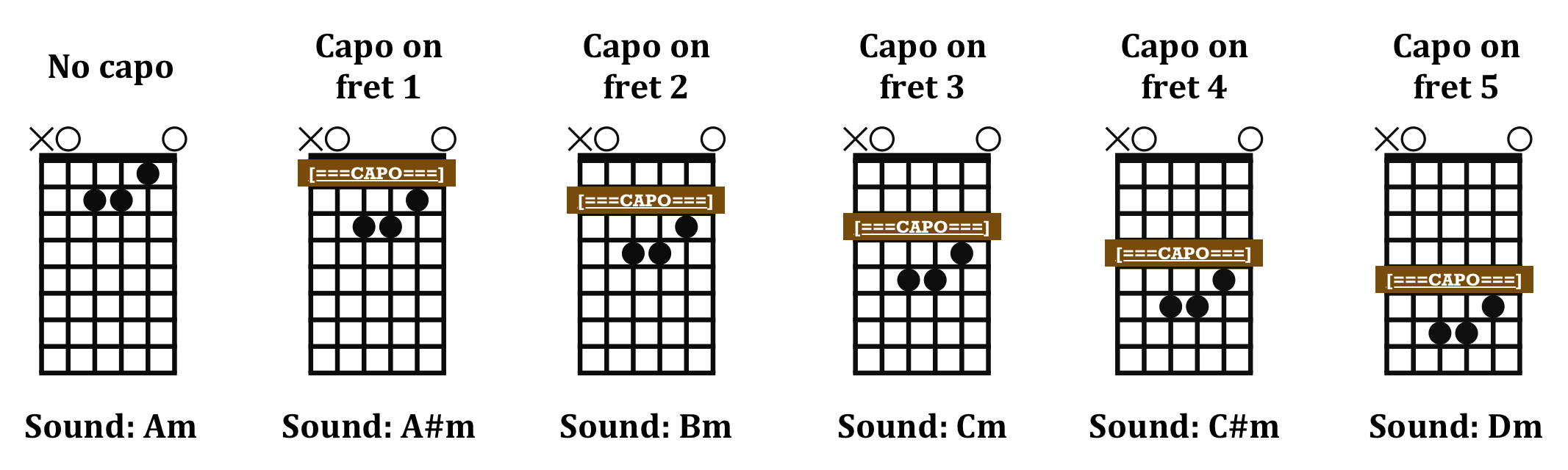
If you’ve ever wanted to learn a song, but have been thwarted by the array of complex chord shapes you’re presented with, then this is the function you need.
Capo Reference Chart
From there, it’s easy to play classic songs in the original recording key. You won’t be referring to a chord dictionary every five seconds to learn an obscure, one-time-use chord shape. In short, you can get on with the most fun part of guitar playing; the playing itself.
As we’ve talked about in a previous post, your guitar capo is an amazing creative tool when it comes to unlocking new sounds. But, while it’s all well and good coming up with a new and exciting riff while using your capo, communicating that riff to capo-less band mates/jamming buddies is sometimes a challenge.

Now that you’ve worked out what you’re actually playing, you can communicate that information to the other musicians you’re with, making the process of jamming much more fun!
The Underappreciated Art Of Using A Capo
In my formative years, my guitar teacher Jean-Marc Guenette gave me a set of strumming exercises to work on. These exercises had me counting a series of 16th notes, strumming on some, not on others, all while keeping a constant down-up motion with my right hand.
In 2019, Bryan amassed a collection of songs written in just a couple of months. He and his friends rented an Airbnb in Florida, threw some mattresses on the walls to create a makeshift studio and recorded what was to be his debut album DeAnn (named after his late mother). It was also around this time that the YouTube video for the song “Heading South” was uploaded to YouTube.

Nashville session guitarist Ray Edenton is often credited with developing this tuning, looking for a way to get more jangle out of the acoustic guitar while reducing the inherent boomy-ness of the instrument. What he got were the jangly characteristics that are common on a 12-string guitar without the lower octaves adding any low end to the sound.: Practice & Theory Stack Exchange is a question and answer site for ians, students, and enthusiasts. It only takes a minute to sign up.
How To Do The Capo On The Guitar: Exercises To Master It
I have a song I'm playing on guitar and the original key is C# minor. If
0 Response to "Guitar Key C Capo"
Posting Komentar