Pretty much all metal bands and most hard rock bands these days tune their guitars down to achieve that heavy, throaty kind of sound. If you have tried to down tune your guitar, you know that it’s not as easy as just dropping the tuning especially if you have a Floyd Rose bridge. In order to play in drop or low tunings like Drop B or Drop C, you should think about properly setting up your guitar. In this repair instructional article, I will show you how to set up your electric guitar to sound great playing in drop tunings. Here are some great topics on how to get started setting up your electric guitar for drop tunings.
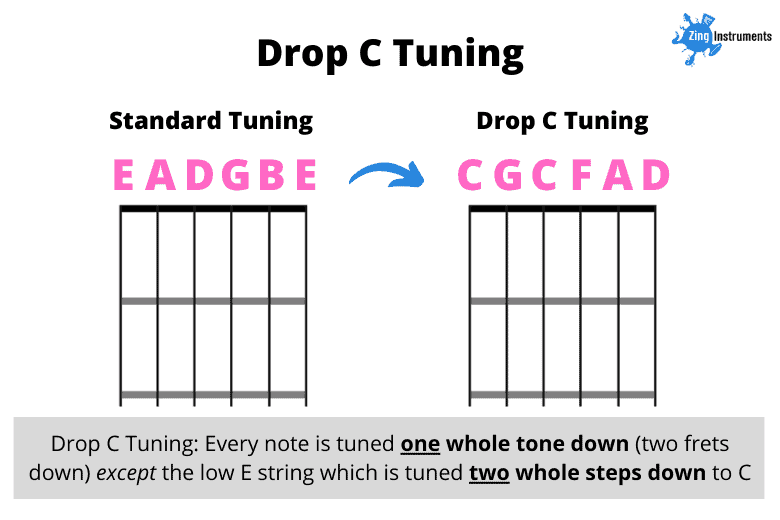
You may have heard of metal bands saying that they drop or lower their guitar tuning down to C or B, but what does that really mean? Well, a standard tuning for a guitar is E-e or E-A-D-G-B-e. In metal, drop tunings, most guitarists play in some style of Drop D tuning. Drop D tuning is the same as standard tuning except the low E is tuned down a full step to D. There are many reasons for lowering the 6th string a full step. I mention a few of them here. Drop C and Drop B tunings are one full step and one and a half full steps down from Drop D tuning, respectively. To tune your guitar is Drop C, simply lower your 6th string to D and then lower all the strings, including the 6th string one full step. Drop C tuning is tuned to C-G-C-F-A-D. You can get to Drop B from Drop C tuning by lowering your strings another half step. Drop B tuning is tuned to B-G♭-B-E-A♭-D♭.

Drop tuning is fun and can give you that low, heavy metal tone without having to play a 7-string guitar. However, I wouldn’t just go lowering your tuning. Your guitar should be set up to handle this change in string tension and pressure. It’s not really a good idea to switch back and forth between standard and drop tunings on a regular basis either. Although changing back and forth without any setup work will probably not “hurt” your guitar, your guitar will just not play or sound as well as it could. Electric guitars need to be set up differently to play and sound good in drop tunings. It’s much easier to have two guitars with one setup in standard and the other setup in drop than to go back and forth with tunings. This might sound like a pat answer, but let’s be honest. All of us gearheads have more than one guitar. Here are some steps to setting up your electric guitar for drop tunings.
Drop C Tuning On?
It is important to get the right gauge guitar strings in order to achieve that low heavy metal sound. You may have noticed that when you drop the tuning on a standard set of strings, gauges .009-.042, to C or B the strings sound floppy and lose all of their tonal qualities. A standard set of strings is meant to be strung up to standard tuning or Drop D tuning. Go figure, right? By lowering the tuning, you are lowering the string tension. In order to play in drop tunings, you will need to get heavier gauge strings. Heavier gauge or thicker strings don’t need to be tightened as high as lighter gauge or thinner strings do. This is the same concept behind bass guitars–they have really thick, loose tension strings to get lower notes. So what strings should you put on your Drop C guitar?
I suggest getting a pack of strings ranging from .012-.056 or higher. D’addario actually came out with a line of strings specifically for Drop-C tuning. The string gauges range from .012-.060. These are great strings; I love them. They have a ton of mass and sound real deep and throaty. I have these strings available; you can buy them on the left side of the page or Click Here.
You can also try light baritone guitar strings. These strings usually range from .013-.062. Baritone guitar strings will give you a nice deep sound for Drop C tuning because all the strings are heavy. These are a nice choice if you like extra heavy strings and don’t want to mess around with buying custom sets or 7-string sets.
Bands That Use Drop C Tuning
If you are like me and think .012 is too heavy for your first string, you can get a custom set of light-top/heavy-bottom strings with a .010 or .011 for the first string. These custom strings give you nice, light treble strings that are easy to bend, but they are still heavy enough to tune down to Drop C. The only problem with strings like this is the bass strings are not as heavy as I like them. You can use them for Drop C tuning, but they sound a little swangy in my opinion.
I want thick bass strings that get me that deep, dark sound, but I also want treble strings that are light enough not to make me bleed while I bend them. That is why I put 7-string guitar strings on some of my guitars. I usually use strings 1-3 and 5-7 for my Drop C tuned, six string guitars. That way I get the best of both worlds. The most common way to use a set of 7-string guitar strings on a Drop C tuned six guitar is just to use the last 6 strings of the 7-string set. These heavier gauge strings will feel stiffer and will be slightly harder to bend especially on the higher strings.

So what strings are right for you? It all depends on your playing style. If your guitar is difficult to play in Drop C with heavy gauge strings, I would suggest using a custom light/heavy string set or a 7-string combination set. The ultimate goal of switching to heavier strings is to get a thicker, heavier string that can produce lower frequencies. Obviously, when you put all these different crazy string gauge combinations on your guitar, you will need to set up the bridge and the guitar to accommodate them.
The Ultimate Guide To 7 String Guitar Tuning
Before we go and put heavier string on your guitar and retune it, let’s take a look at what style of bridge you have. Different electric guitar bridges will affect what type of adjustments you will need to be make with the heavier strings.
Les Paul guitars have Tonepros, Tune-o-Matic, or stop-tail bridges. Stop-tail or hard-tail bridges are fixed to the body of the electric guitar. These bridges come in many different shapes and sizes. For the purposes of Drop tunings, I would also include string-through bridge designs in this category. String-through bridges have a mounted bridge just like a Tonepros bridge.

Instead of having a stop-tail, the string-through bridge has the strings strung through the body and anchored on the backside of the body. All of these bridges are securely attached to the guitar body and will not move from a change in string tension. There are no necessary adjustments that need to be made to set up these fixed bridges for drop tunings because the bridge never moves. You may however want to check the bridge height. With thicker stings, the bridge may need to be raised. Please scroll down to see the action and neck adjustments that might have to be made because of these thicker strings.
How To Change Tunings And Other Tuner Options
Unlike the fixed bridges mentioned earlier, a Floyd Rose bridge is floating by the tension of the strings and the tension of the springs inside the body cavity. The guitar strings pull the bridge upward and the spring counterbalance the bridge pulling it back down to the body.
This concept is important to know when setting up your Floyd Rose bridge for heavier strings and drop tunings. The heavier strings will increase the tension on the bridge and the lower tuning will decrease the tension on the bridge.
There is no standard set up procedure for your Floyd Rose bridge. Since both the string gauge and the string-tuning act as variables in this set up, I will show you the general steps to setting up a Floyd Rose bridge. Before you detune your guitar, I would remove the cavity cover on the backside of the guitar and place blocks of wood in between the bridge and the side of the cavity. The blocks will hold the bridge in place while you detune your guitar. I’ve seen some people put a wooden block across the edge bridge cavity under the bridge on the top of the guitar. This holds the bridge in place, but it can also damage your finish. Don’t risk it. Cut a small piece of wood and block your bridge from the inside of the spring cavity.
What String Gauges Should You Be Playing?
As you have probably figured out, without this block, the springs will pull the bridge into the guitar body and bury the saddle screws. This is because of the string tension isn’t there to counterbalance the springs. Don’t worry. All you have to do is grab the whammy bar and pull
Before we go and put heavier string on your guitar and retune it, let’s take a look at what style of bridge you have. Different electric guitar bridges will affect what type of adjustments you will need to be make with the heavier strings.
Les Paul guitars have Tonepros, Tune-o-Matic, or stop-tail bridges. Stop-tail or hard-tail bridges are fixed to the body of the electric guitar. These bridges come in many different shapes and sizes. For the purposes of Drop tunings, I would also include string-through bridge designs in this category. String-through bridges have a mounted bridge just like a Tonepros bridge.
Instead of having a stop-tail, the string-through bridge has the strings strung through the body and anchored on the backside of the body. All of these bridges are securely attached to the guitar body and will not move from a change in string tension. There are no necessary adjustments that need to be made to set up these fixed bridges for drop tunings because the bridge never moves. You may however want to check the bridge height. With thicker stings, the bridge may need to be raised. Please scroll down to see the action and neck adjustments that might have to be made because of these thicker strings.
How To Change Tunings And Other Tuner Options
Unlike the fixed bridges mentioned earlier, a Floyd Rose bridge is floating by the tension of the strings and the tension of the springs inside the body cavity. The guitar strings pull the bridge upward and the spring counterbalance the bridge pulling it back down to the body.
This concept is important to know when setting up your Floyd Rose bridge for heavier strings and drop tunings. The heavier strings will increase the tension on the bridge and the lower tuning will decrease the tension on the bridge.
There is no standard set up procedure for your Floyd Rose bridge. Since both the string gauge and the string-tuning act as variables in this set up, I will show you the general steps to setting up a Floyd Rose bridge. Before you detune your guitar, I would remove the cavity cover on the backside of the guitar and place blocks of wood in between the bridge and the side of the cavity. The blocks will hold the bridge in place while you detune your guitar. I’ve seen some people put a wooden block across the edge bridge cavity under the bridge on the top of the guitar. This holds the bridge in place, but it can also damage your finish. Don’t risk it. Cut a small piece of wood and block your bridge from the inside of the spring cavity.
What String Gauges Should You Be Playing?
As you have probably figured out, without this block, the springs will pull the bridge into the guitar body and bury the saddle screws. This is because of the string tension isn’t there to counterbalance the springs. Don’t worry. All you have to do is grab the whammy bar and pull
0 Response to "Drop C Tuning Guitar Setup"
Posting Komentar