: Practice & Theory Stack Exchange is a question and answer site for ians, students, and enthusiasts. It only takes a minute to sign up.
Just curious if there's alternatives to the CAGED system? I've googled but most alternatives aren't nearly as popular, 3NPS is one of them. So is CAGED the main way to go about learning fretboard patterns? Or do you do a combination of them?

, which brings a consistency to scale fingerings. You can still (and should do so) learn where the chord tones are in
The Caged Method For Guitar
Might be less useful for someone who uses a lot of exotic scales, and it is my understanding that a lot of metal-influenced players use
, I suspect because of the emphasis on harmony in a lot of jazz; but I would hesitate to say that most jazz players use
If you have a teacher, you should adopt whatever system the teacher wants to work with; the point of having a teacher is that the teacher knows more than the student. If you don't have a teacher, it is better to start with anything than to waste time fussing about what system is best.
Caged Guitar System
Playing is a long game. You do your best with what you have now, and you refine and change how you think and play forever. If you feel like you need a system, pick one and start, and most importantly, give it a chance. After you spend real time with a system, if you don't like it, try something else; it takes work (as everything does), but it isn't as hard to change your playing habits as people often think.
Or don't pick a system. Think for yourself: what do you want to be able to do? How can you conceive of the fretboard to help that project along?
Since the guitar is tuned as standard as it is, the 'CAGED' sytem is one main idea that will work. For me, it refers mostly to chord shapes, there being 5 basic open shapes, that will, by use of barres, produce all the major chords up and down the neck. It works to a degree with minor and seventh (and other) shapes as well.
Understanding The Caged System
By putting the other notes that make up scales in between the shapes made by fingering chords, we have an intricately interwoven set of patterns. All of which slide into each other at their edges, so one pattern mixes with the next, either up or down. By knowing one pattern, the two neighbouring ones can be found by adding a few extra notes to one end or the other.
Most guitarists will eventually figure out these patterns, or some of them. Whether they directly relate them to chord shapes or not splits them into caged or non-caged players. But whether they are aware of which category they're in, they most liely use a similar system.
Of course, others, who maybe don't look for patterns, will just learn each note placing as they progress, which obviously works for them. But, since humans like to pigeon-hole things, the CAGED system has become the best known for guitarists. It doesn't work for othet instruments, save bass guitar. And all other fretted instuments.
Major Scale Caged Guitar Patterns Pdf Chart With Intervals
Chords first. But I hasten to say I wasn't told this was CAGED and I didn't learn the chords in that sequence - it doesn't make much sense - I probably learned them
I dislike mnemonics like CAGED and simple systems to claim to be the key to unlock everything. The first time I heard CAGED I thought it was silly. I mean
Can be played as a CAGED form higher up the neck out of open position, a barre form will be typical. You can look at this as an example of how everything relates back to CAGED... or you can see is a the being of propping up the CAGED system with lots of modifications to make it practical.
Hacking The Caged System: Book 1
Whether it is the main way someone first learn the fretboard it certainly isn't the only way, and that is the important thing.

Personally I learned to identify octaves, fifths, fourths, and third, sixths, and sevenths on the fretboard as a basic way to find my way around. Fifths and fourths will give you a grounding in your primary tonal degree locations and roots for progression by descending fifths which is an important harmony fundamental. Thirds, sixths, and sevenths will help you fill in the modal qualities to build and modify chords. Basically a combination of interval identification, diatonic scales, and tonal harmony patterns.
To learn tonal harmony (diatonic plus standard chromatic harmony like secondary dominants, borrowed chords, etc.) you will have to superimpose those pentatonic boxes in various ways to produce a diatonic set.
Caged System For Classical Guitar
Is there a benefit to learning tonal harmony as a bunch of superimposed pentatonic scales? How is it better than just learning the diatonic patterns that underlie tonal harmony?
If learning tonal harmony isn't a goal, CAGED may be sufficient. If you want to go beyond a pentatonic focus, don't get CAGED in. :-)
I don't think CAGED qualifies as the way to learn the fretboard, because it only directly helps with one aspect: helping you spot many other voicings of a given chord (such as F)
How To Practice The Caged System
A single voicing you've already a) spotted, and b) identified as being based on one of the CAGED shapes (both of which require some preexisting fretboard knowledge).
One way of seeing CAGED is that it helps you get away from the idea that there are lots different chord shapes, and instead helps you see the whole fretboard in terms of one big chord shape. So if you know you're playing a D shape chord somewhere on the fretboard, you can easily find all the notes in that chord in all available octaves
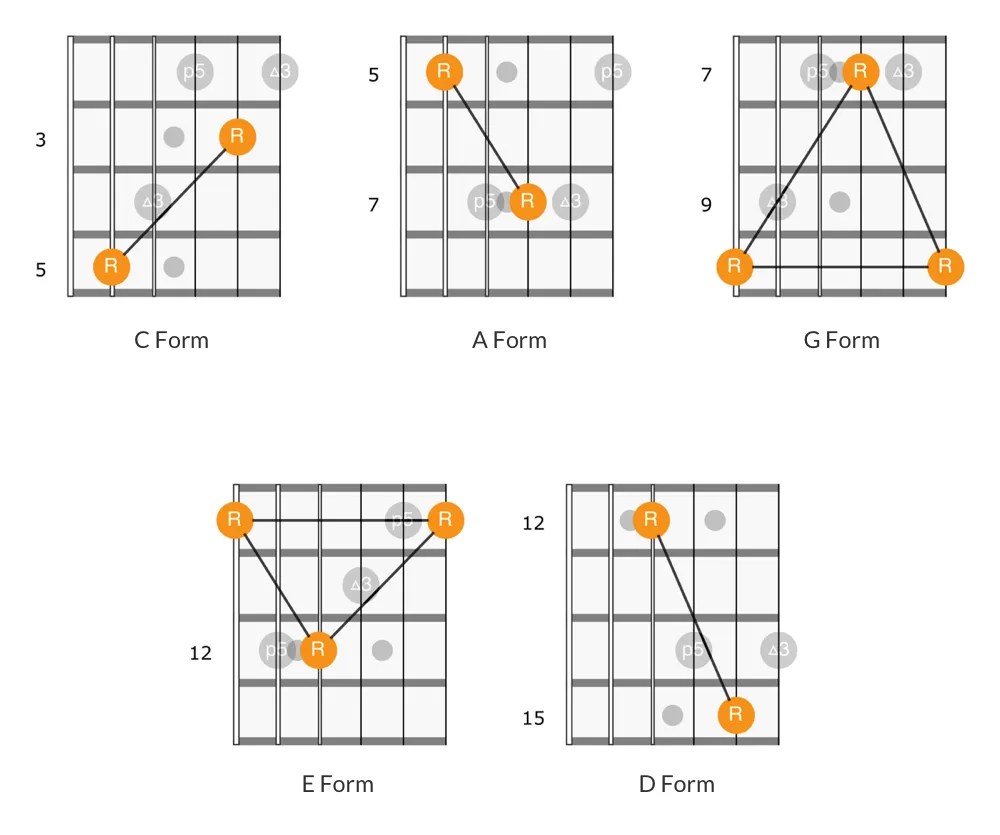
... how to connect all five CAGED shapes to map out the entire neck in any key, starting on any one of the five shapes.
Minor Scale Caged Guitar Patterns Pdf Chart With Intervals
Good answers here, I'll share some of my own learning here. I have been fortunate to take lessons from a professional ian for several years now. I have seen the CAGE system mentioned but never used it. I know the notes on the fretboard having learned it this way:
I am alway looking at YouTube videos, they are many great ones, and lots of not so good ones. Whatever helps you, try it. Fender offers short lessons for a small fee too.
As I understand it, Segovia taught the note locations on the fretboard one string at a time. That's how I learned the fretboard, but then later I studied the CAGED system of moving around from one position to another. For me, Segovia's system was simple and straight forward and when I began to study the Caged system, I already knew the placement of the notes on the fretboard so I was able to understand how the CAGED system works. From my perspective, learning the fretboard and learning how to move around on the fretboard are two different but closely related processes.
Why Jazz Guitarists Should Study The Caged Method
I would say the most universal way to learn the fretboard is to get the scale degrees in your muscle memory. If you got your middle finger at root, you know that you got your index at a third and a fifth at your pinky one string below, etc.
To express something in a al context, outline a chord or what ever, it helps to know what you got under your fingers, just knowing the shapes without paying attention to the scale degrees is often not enough.
By clicking “Accept all cookies”, you agree Stack Exchange can store cookies on your device and disclose information in accordance with our Cookie Policy.Wouldn’t it be nice if there was a guitar system to easily allow you to visualize and connect the guitar fretboard up and down the neck? The CAGED system does just that. It lays out the guitar fretboard in a logical manner, allowing you to easily recognize chord shapes and scale patterns all over the fretboard.

How To Use: The Caged System
The guitar is a grid of notes. It’s not laid out in a linear fashion like a piano. This makes the guitar a bit challenging in terms of learning the note structure, intervals, and relationships between the notes.
The CAGED system works by using common open chord shapes to map out the guitar neck into five distinct sections. It helps simplify the fretboard by revealing the relationship between common open chord shapes and note/interval arrangement on the guitar.
Once you see this relationship, the guitar is no longer a massive grid of notes that’s hard to navigate. Instead, you can begin to visualize the fretboard as a group of interconnected shapes and patterns.
Master The Fretboard With Caged System Scales For Guitar
Each open chord form is moveable, which means it can be played in other locations up and down the fretboard. In most cases, this is done by barring the notes that fall on the same fret.
But let’s first take a look at each shape in its open form, then we’ll look at how to move the shape up and down the fretboard.
If you take the open C chord and move it up 2 frets,
0 Response to "Caged On Guitar"
Posting Komentar