Douglas Niedt is a successful concert and recording artist and highly respected master classical guitar teacher with 50 years of teaching experience. He is Associate Professor of Music (retired), at the Conservatory of Music and Dance, University of Missouri-Kansas City and a Fellow of the Henry W. Bloch School of Management—Regnier Institute for Entrepreneurship and Innovation.
Doug studied with such diverse masters as Andrés Segovia, Pepe Romero, Christopher Parkening, Narciso Yepes, Oscar Ghiglia, and Jorge Morel. Therefore, Doug provides solutions for you from a variety of perspectives and schools of thought.

He gives accurate, reliable advice that has been tested in performance on the concert stage that will work for you at home.
Practice Guitar Routine
My name's Gretchen, and I'm so happy I purchased an All-Access Pass to the Vault. I love your awesome technique tips. I'm amazed how much I have improved my playing.
ARE YOU LOOKING FOR PROVEN STRATEGIES THAT WILL MAKE YOU A BETTER GUITARIST? Check out the game-changing tips in my Vault—I promise they will kick your playing up to the next level. Purchase an All-Access Pass to the Vault. It's a one-time purchase of only $36! You receive full access to:
Join the club. Most classical guitarists don't confidently know the right-hand fingering of their pieces well enough to play the right hand alone. But why in the world would you want to spend hours practicing the classical guitar with the right hand alone?
Hello Guys! I've Been Trying To Learn Classical Guitar By Myself For A Year Now But I Feel Like I Really Need To Improve My Right Hand, Especially My Ring Finger As
Yes, we could make many of these improvements by practicing both hands together. BUT, it is far more effective and efficient to practice the right hand alone.
PRACTICE WITH THE RIGHT HAND ALONE ON THE CLASSICAL GUITAR IS THE MOST EFFICIENT WAY TO CORRECT PROBLEMS AND WEAKNESSES OF THE RIGHT HAND We can make improvements in our right-hand classical guitar technique faster and far more efficiently if we practice the right hand alone. Here are five reasons why:
To practice the classical guitar with the right hand alone, the first thing we need to do is figure out which strings we are supposed to pluck. If you have never tried to play a classical guitar piece with the right hand alone, you may find this is difficult to do. But it is fairly easy on a piece that uses a consistent right-hand fingering, such as an arpeggio. Let's look at the first sixteen measures of the famous anonymous Romance, or Romanza, or Romance de Amor. Example #1:
How To Play Guitar Faster: Right Hand Picking Technique Explained
If you look at the standard notation, you see the symbols for the right-hand fingering (a, m, i, and p.) The circled numbers are the string numbers. We have a pattern that repeats over and over:
It is even easier to figure out which strings to pluck if you focus on the tab. Ignore the fret numbers. Focus on the six horizontal lines that tell you which string to pluck. Example #3:
On a repetitive piece like Romance, you may not need to rewrite the music. You may be able to look at the standard notation or tab, convert the notes to open strings in your head, and immediately practice the music on the open strings.
Right Hand Finger Playing Exercise 2 Examples
But it is more difficult to extract the open strings from a piece or passage that contains a mixture of intervals and scalar melodies, even on an easy piece such as Mauro Giuliani's Scottish Dance. This version is from Charles Duncan's A Modern Approach to Classical Guitar Repertoire, Part 1. Example #5:
It takes some effort, but from the standard notation, we can rewrite the music (or rethink it in our head) as open strings. For each note, ask yourself, Which string do I pluck to play this note? and play it as an open string. Example #6:

Although it is more difficult to extract the right-hand fingering from a complex passage, remember that the benefits of practicing the right hand alone increase exponentially with the complexity of the right-hand fingering.
Reasons To Practice The Classical Guitar With The Right Hand Alone
Now that you understand how to extract the right hand alone from a piece of music, I will explain how you can use this ability to improve your playing in 27 ways!
THE BENEFITS OF PRACTICING THE CLASSICAL GUITAR WITH THE RIGHT HAND ALONE The Basics 1. Practice the right hand alone on the classical guitar to improve or correct your right-hand position
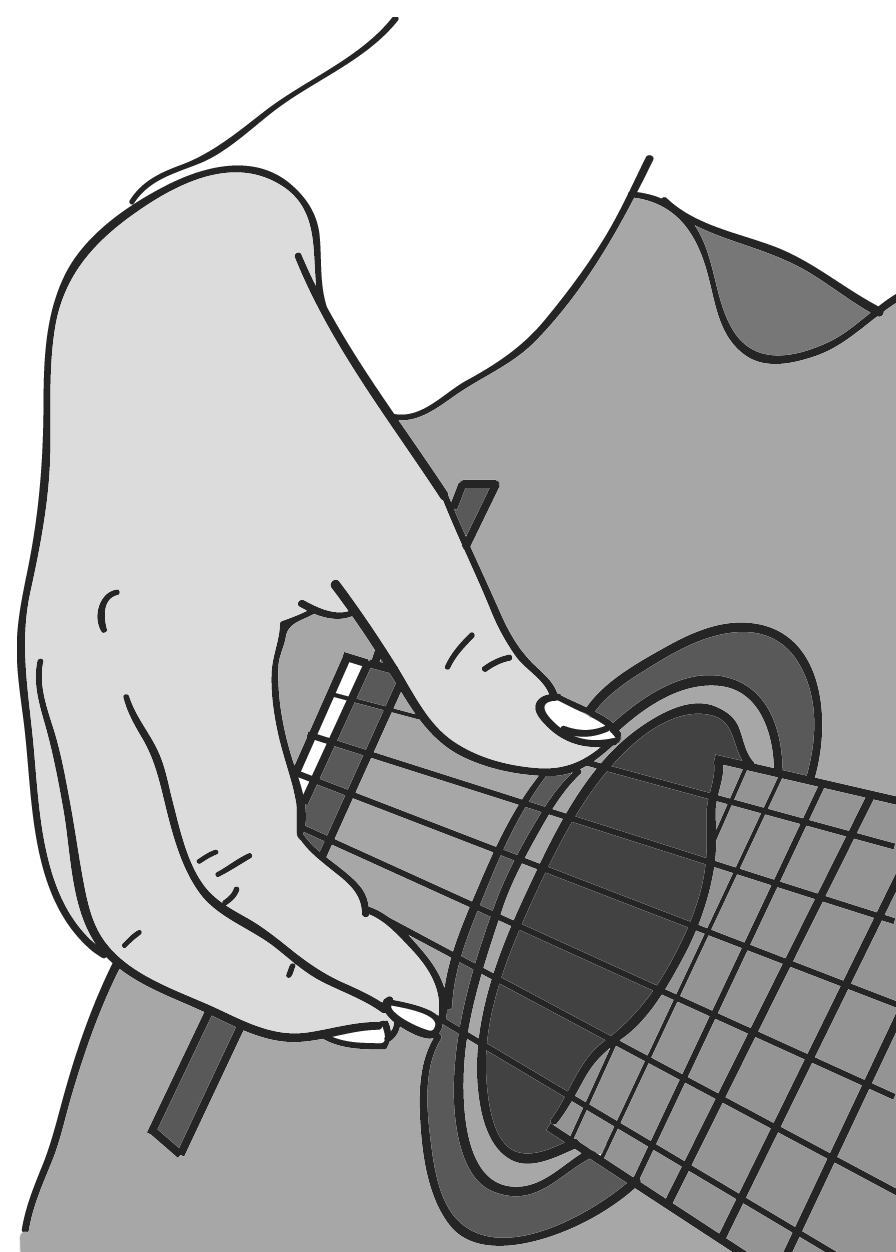
Let's use our Romance as an example. One common problem is that the right hand may tilt to the right. To correct it, we can observe the top of the hand. The top of the hand should be parallel with the top of the guitar.
Sitar: Basic Practice For Right Hand
Or, we can observe the position of the a finger on the first string. If you lean your head to the right (not your body, just your head), you can peak through at the a finger. It should stand perpendicularly to the string or lean slightly to the left:
For a thorough discussion of the classical guitar right-hand position, see my technique tip, How to Find a Good Right-Hand Position for Classical Guitar.

In Romance, it would be very difficult to correct the position of the right hand while also playing the left hand. We would have to constantly take our eyes off the right hand to watch the shifts and bar chord placement of the left hand.
Lesson 3: The Right Hand Position
But if we play the right hand alone, we can give our total focus and concentration to the wrist position or the position of the a finger as it plucks the first string. You may ask, Doug, why not just practice the pattern of the first measure over and over on open strings? You could do that, but having the right-hand play the exact strings of the piece is much more relevant to our goal of playing the piece correctly. Also, on pieces with more complex and ever-changing note configurations (like the Scottish Dance), it will not be possible to devise simple, repetitive exercises to fix a problem with the hand position. You must play the actual piece, or passages from the piece, right hand alone.
2. Practice the classical guitar with the right hand alone to improve the flesh/nail contact of your fingers and thumb and improve your tone quality.
For a thorough understanding of this topic, see my four-part technique tip, How to Produce a Good Tone on the Classical Guitar.
Video Yourself For Guitar Practice And Be Your Own Teacher
It is difficult to observe the details of correct flesh/fingernail contact of the fingers and thumb while trying to play the notes and chords on the left hand. We need to focus 100% on the right hand. Practicing the right hand alone is a fantastic way to improve the consistency of fingernail/thumbnail contact and thus improve our tone quality. When you don't look at the left hand, it will amaze you how much more sensitive your hearing and touch become and how much your awareness of your sound increases.
3. Practice the classical guitar with the right hand alone to learn to release finger tension after plucking with free stroke. Make small finger movements.

See my technique tip, A Secret to a Relaxed Right Hand on the Classical Guitar—The Pluck-Return Free Stroke, for a comprehensive explanation of the technique. In the next video, I explain the basics of how to execute the pluck-return free stroke. As you will see, you must keep track of many details to execute the technique correctly. The only way to monitor those details is to practice at first with the right hand alone, on simple open-string exercises. Don't try to learn the technique on a piece.
Right And Left Hand Fingerings For Guitar And Bass
Once you are comfortable with the technique on the simple open-string exercises, it is essential to apply it to your actual pieces. And the best way to do that is to extract the open strings so you can practice the piece with the right hand alone.
Sometimes, we decide to use the planting technique for our right hand on a piece or passage. Our intention is very clear in our mind. But when we play the piece, we allow the difficulties of the left hand to hijack our attention and focus, and we discover (or our teacher tells us) the right hand is no longer executing its planting technique correctly.
For example, if we intend to play Leyenda (Asturias) at a fast tempo, in measures #41-44 (and many others in the piece), we must plant our right-hand fingers when our thumb plucks each melody note in the bass. Planting enables us to play this arpeggio at high speed with stability and precision. Example #8:
The Title Of Your Publicationmastering Classical Guitar Technique: Tips For Perfecting Your Sound By Douglas Niedt
However, to learn to apply the planting technique or to fine-tune it, we must repeat the passage many times. Practicing with both hands together would quickly tire the left hand due to the continuous bar chords we must hold. Here is a perfect opportunity to extract the open strings of the passage for intensive right-hand practice.
Now, we can focus 100% on our planting technique without fatiguing the left hand. Practicing the right hand alone will also prevent the transfer of tension from the left hand to the right hand. Adding tension to the right hand would hamper our efforts to learn or fine-tune our planting technique.
If a piece or passage, whether easy
0 Response to "How To Practice Right Hand On Guitar"
Posting Komentar