The first schematic describes a 100 watt Guitar amplifier circuit which can be used mainly for amplifying guitar sound and also a public address systems. The next schematic in this article explains yet another guitar amplifier enhanced with fuzz effect generator and treble booster circuits.
To test its ruggedness, the unit is designed without any ancillary equipment like volume control. Furthermore, an appropriate pre-amplifier must be installed beforehand, which is comprehensively explained in this article.

Not only does the exterior look tough, but also the performance of this amplifier that manages over 100 watts endlessly using a sine-wave input.
Simple Guitar Amplifier Using Tl071
The frequency response is undeniably flat at 50 Hz to 20 kHz, with a total harmonic distortion of less than 0.5% (0.1 W to 80 W).
You can connect multiple speakers from this amplifier on one condition; the total impedance must be equal or more than 4 Ω.
Parallel output transistors are used for an enhanced output capacity while transistors Q6 and Q7 connected in Darlington pair deliver a current gain.
Build A High Quality Audio Amplifier With The Lm1875
Around 10 mA is provided by the current regulator Q3. This controlled current channels through Q4 and activates the bias for the output stage, and Q5.
The collector voltage at Q5 is determined by its base-emitter voltage. An extremely high voltage gain is present in this transistor because it is operating almost at constant current.
The differential pair Q1 and Q2 controls transistor Q5. As a result of the negative feedback through R7 and R9, Q1 and Q2 function like an error amplifier. So, it attempts to retain the voltage at its two inputs at the bases of Q1 and Q2 constant.
W Tube Power Amp
Therefore, the output voltage is made equal to the input voltage multiplied by (R9+R7)/R7. Resultantly, the amplifier will have a voltage gain of around 22. Changing the value of R7 will allow the voltage gain to vary.
An apt adjustment must also be made to C6 because R7/C6 regulate the lower -3dB point. You must ensure to not change the value of R9.
RV1 which is a 470 Ohms preset, sets the output bias current which is essential to avoid cross-over distortion. This may be done with the help of the following points.
W Power Audio Amplifier Circut
Attach, small 100 mA or 50 mA filament bulbs in series with the two supply line inputs (-40 V and +40 V lines).
Ensure that all capacitors, diodes and transistors are correctly placed. On Q3 and Q5, metal “fin” type of heatsinks are utilized. Double-check that the heatsink has enough space between the other parts.
Keep in mind that the heatsink will be a little slanted and the transistor somewhat curved. This is to give space for fastening the heatsink to the “metal side” of the transistors. Always make sure that insulating washers are installed.
Watt Power Amplifier Circuit Diagram Using Mosfets
The PCB for this guitar amplifier circuit should be fitted against the lid of the metal box and short connecting leads should be connected between the boards to the transistors’ outputs which are plugged on the flip side of this lid.
To make sure the PCB does not touch with the inner face of the lid, countersunk screws and washers are utilized. It is fundamental to install the fasteners at this stage but avoid fixing the board altogether.
The heatsinks for the output transistors must be installed now, and ensure the transistors are in their right locations. Remember to include the insulating washers.
General Purpose 2 Watt Stereo Power Amplifier
The short leads must be connected to the emitter, base and collector of the output transistors. This connection to the collectors is done using the transistor mounting screw.
Next, firmly attach transistor Q4 into its heatsink. In the PCB, place the metal joining pins for terminating connections to the output transistors Q8, Q9, Q10 and Q11. The positions of the pin are visibly etched on the PCB overlay.

After that, plug all the leads from the power supply into the PCB. Then, fix the board on top of the leads from the output transistors and fasten them tightly.
Marshal V.120pa Power Amplifier Pcb Layout
Solder the leads from the diverse external connections to the selected pins on the board. Try not to turn the wire around the pins by more than half a turn. Else, when you need to detach it (for some reasons), it will be tough.
Finally, assemble all remaining parts. Ensure the mains earth lead is firmly fixed to the case as it acts as a transformer shield too. The input shield must be earthed to the case directly at the input socket.
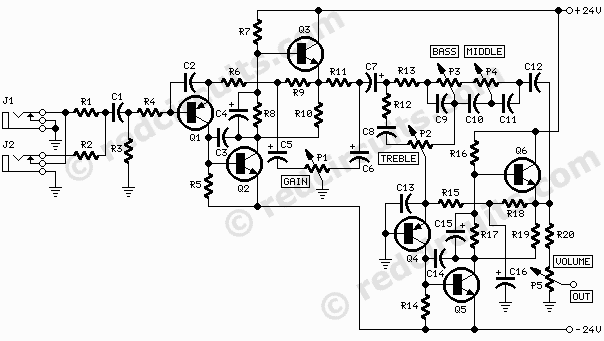
Referring to the above guitar amplifier with fuzz effect and treble booster schematic, we can understand the working of the circuit with the following points:
Tda2030 10w Audio Amplifier Circuit
The output from the guitar is fed to the 741-based preamp 1C1. The output of the preamp is supplied to the mixer directly. It is also fed to a high-pass filter built around IC2 that acts like a treble booster, and a high-gain amp for clipping, in order to generate the fuzz. effect. The mixer receives the filtered output of IC2.
The output of integrated circuit IC4 also connects to the mixer. As a result, the mixer receives dynamic, in-phase inputs that can be clipped, fuzzed, differentiated, or pointy, as well as with an enhanced treble effect.
Setting up several mixer inputs is half the joy of using this fuzz effect enhanced guitar amplifier circuit! The output of the mixer connects to the buffer IC6.
W Power Audio Amplifier Circuit » Circuitszone.com
The buffered output connects to IC7, the LM384 power audio amp, through a volume-control potentiometer. Ensure that IC7's unused pins are all grounded.
Finally your guitar skills is displayed to everybody nearby through an 8-ohm speaker, with enhanced fuzz effect and a truly boosted treble output.

The level of output signal delivered by most electric guitars will certainly not be sufficient to overdrive the above exlained 100 watt guitar amplifier.
How Amps Work
However, the input stage of the guitar amplifier might clip the output from the preamplifier, if the signal exceeds the required limit.
Just one LF 356 delivers the required amplification, that is determined by the ratio of R2 + R3 + P1 to R3 + P1. The input impedance, which, at 1 M, may be pretty high, is specified by R1 since the op -amp includes FET inputs.
This can be a appropriate impedance for the majority of guitar pick-ups. A 9 V battery supplies the power supply which is transformed into a balanced +/ -4.5 V for the op-amp through R4, R5, C3, and C4.
Circuit Of The Construction Of A 10 W Practice Guitar Amplifier
Current draw of this guitar preamplifier will be approximately 5 mA. The design including battery could simply be installed inside a tiny enclosure.
If a plug/socket connectors are fitted on the cabinet, the preamp can easily be hooked up into the guitar. If this is executed, preset P1 could be substituted with any standard potentiometer to facilitate quick amplification control using the pot knob protruding from the case.
I wish to submit to you my schematic for a guitar Preamp. This Preamp incorporates a very unique way of cancelling any noise on the power supply. The 33K resistors are in parallel, because of the zero resistance of the power supply. This forms a gain determining resistance of 16.5K.
Audio Amplifier Lm3886
A 50K resistor is placed in series with that 16.5K to form a bias resistance of 66.5K that is applied to the non inverting input.
Should there be any noise on the power supply, the noise divides by two where the 33K resistors meet. That noise is coupled through the 0.68Uf capacitor to the inverting input, and also coupled through the 50K resistor to the non inverting input.
The amplified noises cancel each other at the output. The 0.22Uf capacitor ac couples the audio input signal. The 2.2Uf capacitor ac couples the audio output signal. Voltage gain = .75 × ((1+(68000/16500)). 3.841 as shown. (11.7 db) This is because 25% of my audio input signal is ac coupled to the inverting input.
Inside A Guitar Amplifier
The difference is that this circuit has two buffered outputs to drive the left and right channel RCA inputs on Home Stereo or P.A. equipment. I will attach both the original and improved schematics for you to compare.
I am an electronic engineer (dipIETE ), hobbyist, inventor, schematic/PCB designer, manufacturer. I am also the founder of the website: https:///, where I love sharing my innovative circuit ideas and tutorials.SPKR One or more speakers wired in series or in parallel. Total resulting impedance: 8 or 4 Ohm. Minimum power handling: 75W
This design adopts a well established circuit topology for the power amplifier, using a single-rail supply of about 60V and capacitor-coupling for the speaker(s). The advantages for a guitar amplifier are the very simple circuitry, even for comparatively high power outputs, and a certain built-in degree of loudspeaker protection, due to capacitor C8, preventing the voltage supply to be conveyed into loudspeakers in case of output transistors' failure.
Simple 40 Watt Power Amplifier
The preamp is powered by the same 60V rails as the power amplifier, allowing to implement a two-transistors gain-block capable of delivering about 20V RMS output. This provides a very high input overload capability.
The value listed for C8 is the minimum suggested value. A 3300µF capacitor or two 2200µF capacitors wired in parallel would be a better choice.
The Darlington transistor types listed could be too over sized for such a design. You can substitute them
0 Response to "Guitar Power Amp Circuit"
Posting Komentar