There comes a time when every beginner guitar player will need to consider how to level up their playing skills. Sure, it’s easy to learn how to play songs by reading chord charts and guitar tablature. And for some players, that’s more than enough.
Others may want to explore all that playing guitar has to offer and further develop their skills to an advanced level. One of the best ways to kickstart your guitar playing into high gear is to learn all of the notes on the fretboard, also known as the fingerboard. Knowing what notes you are playing is a large part of having a greater understanding of overall music theory. Spending some time learning the guitar fretboard and notes is a good way to go when moving up to the next phases of your playing career.

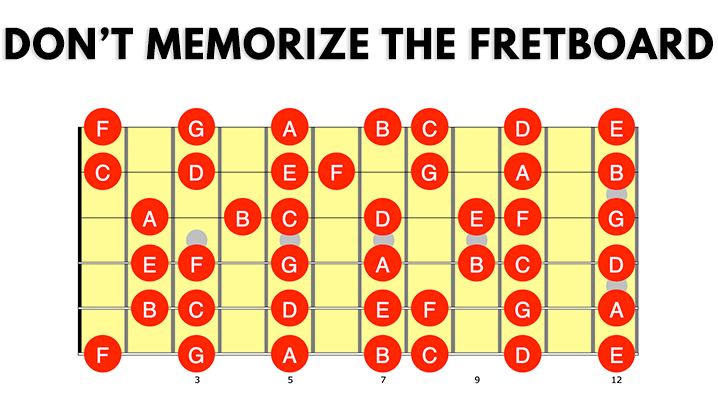
Before we get into what we can do to make learning the notes on the fretboard a lot easier, we need to take a look at a complete guitar fretboard diagram, as shown below:
How To Master Guitar Fretboard Notes
You might already have noticed that some notes seem to have two names. You’ll see that each one has a note with a sharp (#) and a note with a flat (b). This is because these notes are ‘in between’ notes that are identified with just one letter.
For example, look at the note on the fifth fret of the A string—it’s a D. Go two frets up to the seventh fret and you have an E. So what about the note in the middle on the sixth fret? How to read this note depends on the context and point of view. If you take the E note and lower it one fret, you have an Eb. At the same time, if you take the D note and raise it one fret you have a D#. Same note, same string, same location on the fretboard. The point is that both names mean the same note.
The ‘Chromatic Scale’ in traditional Western music theory simply refers to every one of the 12 available notes. Starting with a C note the scale is spelled out as follows:
Learning The Guitar Fretboard Notes
The pattern will repeat itself over and over no matter what note you start on and each note is one fret apart.
Pick a note—any note. Let’s say you play the note on the third fret of the low E string. According to the chart we just looked at, that’s a G. So what would the note on the sixth fret be? If you know the chromatic scale, you’ll know that three notes up from a G is an A#/Bb.
Since each note is one fret apart, it’s simple—the note on the sixth fret on the low E string is A#/Bb. Once you are able to memorize the chromatic scale, knowing the guitar fretboard will come as easy as that.
Guitar Fretboard Wood: The Ultimate Guide To Fingerboard Wood Types
An ‘octave’ is a note that has the same letter name as another note. The big difference here is that the pitch is one octave higher (or lower, depending on where you start).
Let’s look at an example. Play an open D string. Now play the note on the twelfth fret of the D string. Looking at our fretboard diagram, you’ll see that both of them are D notes—it’s just that the one on the twelfth fret has a higher pitch.
How does this help you to navigate the fretboard? Let’s say that you know that the note which is four frets up from the open D string is an F#/Gb. The key here is that the same pattern is true no matter what D note on the fretboard you have started from. There also is a D note on the third fret of the B string. Guess what the note is when you play four frets up to the seventh fret? You guessed it—it’s an F#/Gb as well!
Things You Need To Know About Your Fretboard
Taking it one small step at a time when memorizing notes on the guitar fretboard can keep things from getting too overwhelming. Don’t put too much pressure on yourself! What many guitarists will do instead is focus on memorizing the notes on the low E and A strings. So start with the two lowest strings and work your way up from there.
Why? Because many of the chords that you will play (particularly barre chords) have their root note on one of those two strings. Once you have it firmly in your head that, for example, the note on the eighth fret of the low E string is a C note, you’ll know where to play the right fingering for a C chord. The same is true for the note on the third fret of the A string—that’s a C note too, in case you were wondering.

From there, it’s a matter of expanding your knowledge of patterns. Here’s an eye opener for you—once you have the notes memorized on the low E string, take a look at the high E. Notice anything? The note names for the corresponding frets are the same, but they are two octaves higher.
Easiest Guide To Learning The Notes On Your Guitar Fretboard
As you can see, much of learning the fretboard involves memorizing simple patterns. It sounds more challenging than it really is and with a little time, you’ll know your way around the frets like a pro. So keep practicing and exploring that fretboard!
The best tip we can give overall is to not let yourself get overwhelmed. Take your time, don’t rush things and make sure that you really understand a concept or a particular pattern before you move on to something bigger.
Learning the notes on the guitar fretboard is the key to playing at a higher skill level. Any effort you put into it will be time well-spent and your playing will do nothing but get better and better as your knowledge grows.
Guitar Fretboard & Music Scales Chart
How To Guides How to Play the D Chord on Guitar One major guitar chord that’s needed in many popular songs regardless of genre and style is the D major chord. Along with a handful of other basic guitar chords, such as the C, A, and G chords, you should also learn how to… Read more How To Guides How to Play the Bm Guitar Chord Posted on April 14, 2023 How To Guides How to Play the C Chord on Guitar Posted on April 12, 2023 Article How to Play the B Chord on Guitar Posted on January 31, 2023Guitar Fretboard Notes | Complete Tutorial A Beginner's Guide to Learn the Guitar Neck (+ Guitar Notes Chart Pdf and Notes Training Webapp)
Often, we never bother to learn the notes of the guitar fretboard , but we keep relying on fixed chord shapes and scales patterns (don't miss our free chords and scales pdf).
And why we guitarists should we not do the same? On this page, you're going to learn how and why to learn all fretboard notes .
Learning The Guitar Fretboard Notes [bonus: Guitar Notes Chart]
This will help you understand the fretboard step-by-step , starting from a fretboard map with natural notes only , and introducing one sharp or flat note at a time.
Click on a fret or select the name of a note and the tool will tell you the note or the fret position. (like this interactive tools? Check the other guitar learning software )
If you need help deciphering this map, for now just know that in the diagram the thickest string (E) is at the bottom of the image, and the guitar headstock is on the left .
Guitar Notes Chart: How To Master The Fretboard In 3 Steps
Now we're going to learn some strategies that simplify all this stuff (if you want something crazy, I even created a LEGO 3d Model of the fretboard, that should help you visualize the pitches).
It's an helpful tool, but to fully apply it you need to know the name of the notes, so stick with us and go ahead with this tutorial.

Indeed, often in tutorials and videos, you'll encounter instructions like place your finger on the 2nd fret of the 6th string .
How To Clean A Guitar & Clean A Guitar Fretboard Properly
A well-known frequency is 440 Hertz , that is 2 octaves up the pitch of the A open string, 110 Hertz . The Diapason , also called Tuning Fork , a device for tuning the guitar, oscillates at 440 Hertz.
By using a phrase in which the first letter of each word corresponds to the name of a string, our life will be easier.
In the examples below, the names of the strings are ordered from the thickest to the thinnest ( E A D G B E ):
How To Generate Guitar Fretboard Diagram In Windows 11/10
It's perfectly fine to create phrases in the opposite order: from the thinnest string (1st) to the thickest (6th), E B G D A E .
For a more effective memorization, you should create your own phrases ( there are endless possibilities ); here's one of my phrases, with italian words: E mozionanti A vventure D ove G randi B arche E splodono . If you come up with something cool, please share it in the comments below!

These strings, also called external strings (because they are at the upper and lower border of the fretboard) have different pitches, but their note names are the same .
Customize Your Guitar Fretboard In 7 Steps
On chord diagrams,
0 Response to "Guitar On Fretboard"
Posting Komentar