: Practice & Theory Stack Exchange is a question and answer site for ians, students, and enthusiasts. It only takes a minute to sign up.
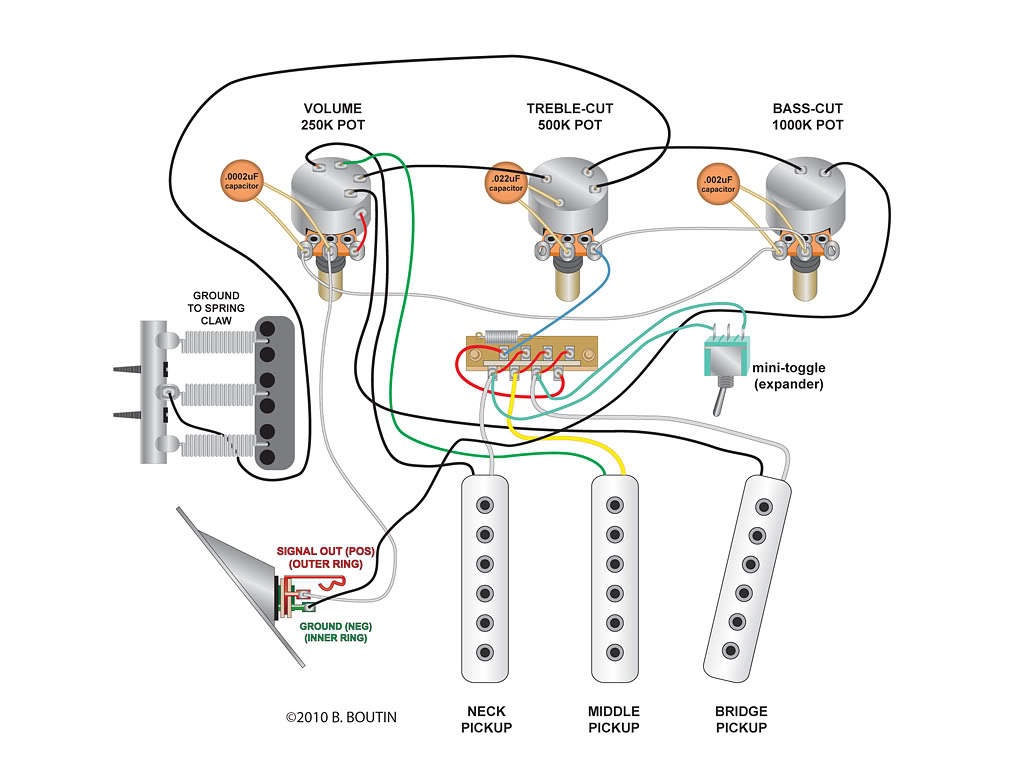
I am trying to wire up a baritone electric guitar with controls similar to a G&L legacy (volume, treble, bass). My question is whether or not I need to change the capacitor values to account for the lower range of the Instrument, and how to figure out what the equivalent values would be if so?

As so often in , it's up to your taste. A bigger cap for the bass-cut might make sense, but preferrably use a properly designed modern circuit instead of that
Different Capacitor Values Needed For Baritone Guitar Tone Controls?
Another matter is the low-cut control. The purpose of this is precisely to tame a too rumbly low end. Note that in the neutral position you short out the capacitor so again its value doesn't matter there. As you turn up the pot, only the high-frequency parts can get through the capacitor whereas the low frequencies are attenuated by the voltage divider consisting of the bass pot and the volume pot (horrible design, this). Now .002 μF is a reasonably low value for a bass-cut capacitor; with the 250 kΩ volume pot that'll give a cutoff at 318 Hz. Sensible value for standard guitar, but on a bariton that's a bit extreme. This
Still be ally useful – the low notes will sound very hollow and may have good rythmic qualities without clashing with the bass. But it's likely enough you would find yourself never fully engaging the bass-cut if its edge is so high, which is a problem because in a middle position this control will
With a slightly bigger bass-cut cap, that wouldn't be a problem, you could just cut it completely and still get some baritone quality but also a full spectrum. Alternatively you could use 500 kΩ also for the volume pot, that would bring the cutoff down to 160 Hz. The downside is that would not be able to
Tone Control Capacitor
Cut the bass anymore at all. (If fact even the 318 Hz might actually not be enough to remove trouble in the
A technically favourable solution would thus be to use an active decoupling circuit before the low-cut. Then you could use that pot to select
Low-cut frequency, and thus get access to all the range from pseudo-bass to clear bariton to hollow jangle. You can get active circuits with properly independent controls for both treble and bass, mostly used for
Complete Guide To Electric Guitar Capacitors
By clicking “Accept all cookies”, you agree Stack Exchange can store cookies on your device and disclose information in accordance with our Cookie Policy.ca·pac·i·tor /kəˈpasədər/ noun a device used to store an electric charge, consisting of one or more pairs of conductors separated by an insulator.
If you found the definition above to be completely inadequate in describing how a capacitor affects your tone, then this article is definitely for you. For anyone just taking in an interest in the electrical components and circuits in their guitar, the ability to truly understand how they work can become very abstract – usually because we tend to try to visualize everything, which is pretty hard to do when it comes to sound and electricity. When you think about a sound after it’s been converted to an electric signal[transduce], what do you see in your mind’s eye? I’m willing to bet that it’s something like this:
You pluck an open E, your pickup’s magnetic field is disrupted and the vibration of the string is inducted by the magnetic coils and the frequencies travel through a copper wire (or silver, if you’re fancy) – so far, you can see everything happening as we go along, but there’s a capacitor in the circuit coming up fast. The frequencies pass through the solder joint, up the little leg into the component. And…something happens in there…

Amazon.com: 2 Pack Electric Guitar Volume Treble Bleed Circuit Kit Sbe Guitar Cap Capacitor With Allen Bradley Resistance
What we know for sure is that the sound is different when it comes out through the output at the end of the line, but how is the tone cap actually affecting the frequencies?
Here, according to definition, our frequencies sit for a brief moment before coming out the other side. Not exactly, let’s forget the definition entirely – it’s a very simple, broad definition that doesn’t really have specific consideration for audio applications. Take a look at your capacitor if you have your circuit handy, or just look at the images below for a moment:
I’ve marked the capacitor wires in blue and given a top and bottom view of the wiring setup – it’s a fairly standard setup, and even though yours may appear a bit different, the capacitor & tone pot are likely the same: one end soldered to the pot’s arm and the second leg is soldered to the bottom of the pot (or somewhere else in the ground circuit). Why doesn’t the whole frequency get grounded off then? Let’s look at the circuit diagram now:
How To Upgrade Your Guitar Pots
The capacitor provides a route to the ground, but only higher frequencies will be able to pass through – the rest will continue to the output.
The capacitor is selectively drawing out the higher frequencies and leaving the lower frequencies untouched to carry along down the line. Note that the bass frequencies are ignoring the law of electricity taking the path of least resistance (to the ground). This is where things get slightly complicated: capacitors are actually meant to divert lower frequencies, which is the opposite of what we actually see happening in the diagram – and of what we know happens when you roll your tone knob around.
All of the frequencies are originally attracted to the path of least resistance, but since the capacitor is holding on to the bass frequencies, they actually pass back into the hot circuit (through the same leg they came in) while the high frequencies are allowed to escape out the ground. Stick a potentiometer just in front of the capacitor in the circuit and turn it up – you are increasing the range of higher frequencies allowed to escape through to the ground. That’s the gist of it! And if we return to the definition about electricity being stored and released, we can picture this happening in the correct sequence with perfect clarity (I hope).
Tone Chasin': The Skinny On Capacitors And Potentiometers (or Caps And Pots)—part 1
If not, then maybe it’d be helpful to think of it as a resistor that only resists lower frequency ranges. The highs and the lows enter the resistor attempting to pass through to the ground circuit – the lows get stopped in the cap and turned away while the highs just skim right past to ground. A higher capacitance value gives a darker tone because a wider range of high frequencies is allowed to escape.
Why does putting a potentiometer right in front of the capacitor only affect the tone instead of the volume? Good question, me. That’s most definitely a question for a potentiometer article though, because it’s going to require a complete breakdown of the pot mechanism as well.
Electricity is confusing sometimes, and it took me some time to go out of the way to research all of this stuff – before that, I would just work off of diagrams knowing A + B = C without any deeper understanding. After I took the time to learn about what I was putting together and how these components are all working with each other (or against in most cases), I had a flood of new questions and theories to find answers for and felt like I was ready to start taking on some more ambitious modifications.
Tone Control Wiring For Your Guitar
So now that we’ve looked at how the capacitor is actually changing the signal, and being selective about it with the help of a variable resistor, let’s get the numbers down. Each capacitor is going to have two numbers associated with it – the value and the voltage. Before we get into the important matters, I want to just narrow your scope of interest and point out that the voltage rating on a capacitor is not going to matter 99% of the time when it comes to electric guitars.

The voltage rating is essentially the amount of electricity that can come through at any given time before it burns out or degrades. A passive guitar’s circuit is only putting in a few volts, so generally any rating over 6 or 7 volts is enough…I can’t remember a time when I even came across a capacitor that wouldn’t be more than suitable. Active pickups put slightly more power into the circuit, usually thanks to a 9v battery.
Sometimes pickup setups are modified to run two 9 volt batteries – still just about nothing when considering that most capacitors are made to handle voltage by the hundreds.
The Guitar Wiring Blog
The value of a capacitor is either written right on the thing or marked with some bands of color that you can decode. Paper in Oil capacitors will often have an alphanumeric code associated with them that you can just run through Google for a quick identification, but Ceramic, Electrolytic, Tantalum, Mica, and Poly Film caps are going to have bands of color that require a bit of math
0 Response to "Capacitor For Guitar Volume Pot"
Posting Komentar